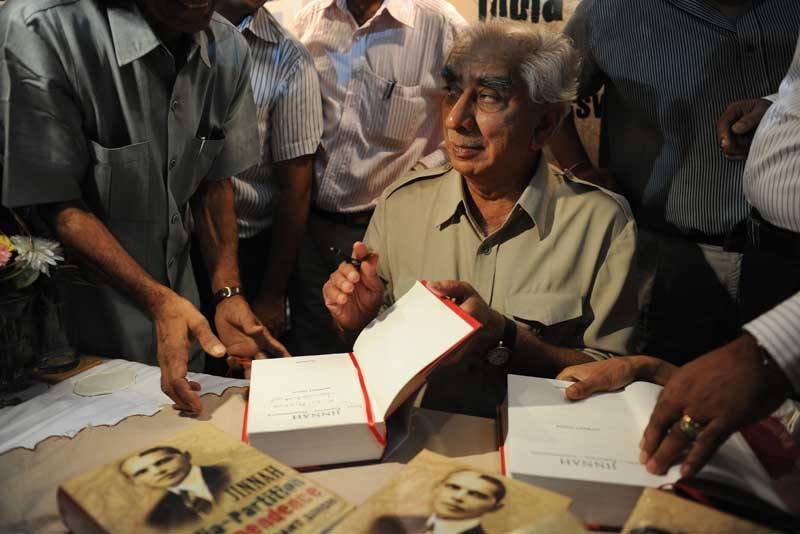
The Partition of India

Excerpt: Indian politician Jaswant Singh summarizes the traumatic events of 1947 on the Asian subcontinent. (1 min., 57 sec.)

NEW YORK, March 25, 2010 - "The partition of India in 1947 was the most traumatic event of the 20th century," said Jaswant Singh, an Indian politician and parliament member. "It continues to live in the psyche, the memories and the hearts of the people both of India, Pakistan and indeed also Bangladesh."

Speaking at Asia Society Headquarters in New York, Singh discussed the events leading up to India's division and subsequent independence with panelists Devesh Kapur, Dir. of the Center for the Advanced Study of India, and Yale University's Steven I. Wilkinson.

Singh, a former senior member of the Hindu nationalist Bharatiya Janata Party (BJP), spoke about his book Jinnah: India-Partition-Independence which explores India's evolution to a predominantly secular, Hindu nation and the birth of the Islamic Republic of Pakistan.

His political biography of Quaid-e-Azam Mohammed Ali Jinnah, who is regarded as the founder of Pakistan, drew enormous controversy when it was released last year and resulted in Singh's expulsion from the BJP.

"The partition is a topic that will and has evoked a passionate reaction and Jaswant Singh's book has generated the same level of discussion," acknowledged Asia Society President Vishakha Desai in her opening remarks.

Singh quoted Mahatma Gandhi who called "the partition of India a vivisection. It is a phrase that is not much liked. The reality remains whether it is Pakistan or India... they are born of the same womb. It was not a natural birth, it was what is called a caesarian section."

He said it is a myth that the partition was peaceful and that the British left in an act of altruism. Instead, he said that by the end of the Second World War, England was a tired country, its financial resources were gone and it wanted to leave the sub continent. "It was not a peaceful transfer of power... At least 13 to 15 million beings lost their lives and many multiple human being lost their homes," said Singh.

Steven I. Wilkinson, Yale University Professor of Political Science and International Affairs, said that while these figures are particularly high by most historical accounts, it is hard to verify exactly how many people died in the partition because so many people were unaccounted for or went "missing."

Wilkinson added Singh's book has a unique historical perspective because as a politician he has a better sense of how other politicians would have acted and seen things at the time.

In his closing remarks, Singh said in the years ahead politicians will continue to delve deep into the reasons for this tragedy but at the time his relatives were bewildered that their country was being cut up and felt no sense of the divisions now felt between Hindus and Muslims.

When asked what role the United States or NATO should play in helping India and Pakistan resolve their longstanding conflict, Singh said  "we will have to solve our problems... How is the North Atlantic going to solve the problems of our region?"

This program is co-sponsored by the Center for the Advanced Study of India (CASI), University of Pennsylvania and CASI's Nand & Jeet Khemka Distinguished Lecture Series.

Reported by Jennifer Mattson, Managing Editor of Asia Society Online

In all the countries, it is the majority who has the final say. If Gandi would press hard for the united states type government, which he proposed and Jinnah supported, then we possibly would not see the millions lives perished, millions became refuge, untold suffering etc. To me it was Nehru and Patel who were in total control of congress, disregarded both Gandhi and Jinnah in the type of Govt india should have after british leaves. The only person, Gandi, could have lead at that time forcefully, but did not. He did not support independent Bengal proposed by Fazlul Haq, Basu and others. Rather he wrote Basu not to oppose division of Bengal. After reading this book, I have lost much of my regards in the leading politicians at that time, specially for Neheru and Patel. I am shocked to see Jaswant Singh expelled from BJP and the reaction of Some indian people towards him. What type of democracy is that? We need better sense to prevail.

the partition of india gave the country an opportunity to rise at its own and partition curtailed all the riots which would have happened as a result of no partition

IN MY OPINION PARTITION OF INDIA IS THE LIVING TESTIMONY OF THE INCOMPETENCE AND LACK OF DIPLOMATIC SKILLS OF MUSLIM/HINDU POLITICIANS ALIKE. AFTER ALL THEY WERE PIECES OF THE SAME CLOTH. READING THE HISTORY OF THE LAST DECADE BEFORE THE PARTITION ONE CAN SEE THE TYPICAL INDIAN CONFUSION AND FALSE EGO THAT IS PROBABLY PART OF OUR NATIONAL PSYCHE. 1. EXCHANGE OF LETTERS BETWEEN JINNAH, GANDHI, NEHRU AZAD AND OTHER LEADING POLITICIANS. LANGUAGE OF THESE LETTERS WAS INTENDED TO SCORE POINTS RATHER THEN HAVING A SERIOUS DECALOGUE. THERE WAS NO NEED TO WRITE LETTERS TO RESOLVE THE DIFFERENCES ON SUCH A SUBJECT THAT CONCERNED THE FATE OF A NATION. IT WAS WASTE OF PRECIOUS TIME. 2. GANDHI CREATED CONFUSION BY REPEATEDLY ADVISING JINNAH TO TALK TO NEHRU OR AZAD AS HE CLAIMED TO HAD NO DECISION MAKING POWER AND WAS NOT EVEN 2 ANNA MEMBER OF THE CONGRESS. WE KNOW THAT IT WAS WRONG. 3. JINNAH REFUSED TO TALK TO AZAD, PRESIDENT OF THE CONGREVE BETWEEN 1940/46. HE CLAIMED THAT AZAD WAS A 'SHOW BOY' USED BY THE HINDU LEADERSHIP. IT WAS A VERY CHILDISH BEHAVIOR AND NOT EXPECTED FROM A MATURE POLITICIAN. MAY BE THE TRAGEDY OF PARTITION HAPPENED BY DEFAULT BUT MUSLIM/HINDU LEADERSHIP CAN NOT BE ABSOLVED FROM THEIR FAILURE AND ITS UNINTENDED RESULT. UNFORTUNATELY THEIR ATTITUDE WAS CASUAL, IRRESPONSIBLE AND FULL OF PERSONAL VANITY. THEY NEVER REALIZED THE SERIOUSNESS OF THEIR FAILURE AND HOW IT WOULD AFFECT THE FATE OF 400 MILLION INDIANS FOR GENERATIONS TO COME. IN MY RESEARCH MAULANA AZAD, AS PRESIDENT OF THE CONGRESS DURING THOSE FATEFUL YEARS, UNDERSTOOD THE CONSEQUENCES AND WORKED SINCERELY FOR THE UNITY. ALAS! MADNESS WON AND REASON FAILED.
As a student of history I have dwelled a lot and tried to understand the situation and tragic events around partition,there is always this dream that if the communal problems were resolved leading to a united India what massive power it would be today dwarfing China, One thing is clear,everything was done in a hurry,British were in a hurry to leave India for better or worse to save their cold lonely island,Jinnah knew that time was limited for him,however I still think that he was not for partition totally and used it as a means to obtain better accomodations for muslims in a loose federation until late 1946,however Nehru and co did not understand that India was no simple country and rule of majority rule which may be case in a smaller country is fraught with danger and does not apply especially with historical perspective of Muslims being in a eminent position in India prior to Britsh rule and their legitimate concerns of being in a perpetual minority with no power or control over their lives, The behaviour of Nehru and company cornered Muslims to Pakistan which was not a good solution for all Muslims as a sizeable population still live in India and Pakistan did not help their situation.
Nasim Yousaf is a scholar and focuses on South Asian studies. He holds Jinnah responsible for partition of India in 1947. He has written extensively on the topic. Interested persons must read the following: 1)"India’s Partition in the Face of Opposition: An Unveiled Perspective" by Nasim Yousaf.This is published by Harvard Asia Quarterly. The Abstract of this piece is given on Allama Mashriqi's website: http://www.allamamashraqi.com/grandsonsarticles.html Also read: 2) "Hidden Facts Behind British India’s Freedom: A Scholarly Look into Allama Mashraqi and Quaid-e-Azam’s Political Conflict"
Congress failed to stop partion. Congress failed aspiration of muslims congress lost popularity in northwest in favor of league. Muslim feared overwelming hindu population Muslim leaders decided that best option is seperate identity from india where muslim make majority in the north west. The north west british india voted for new country called pakistan & defeated the option of seceding to india. Jinnah can't be blamed for the whole partion, he gave choice for the north west the choice of pakistan or india. Pakistanis could not defeat india in warfare for centuries, the british were the last rulers. Jinnah asked them if india could be partioned. The british made two cabinent mission plan for independence. Finally the the partion was offered. Kashmiris and pakistanis have option to secede from india, just like all hindu states merged with india. India was defeated in pakistan, india is defeated in kashmir. This is the reason muslim partioned because muslim aspiration in muslim majority states would be similar to occupied kashmir. Kashmir like pakistan want to secede from india because it does not want controlled government. This book illustrates that finally there is true in Jinnah's story on partion.
Had the congress leaders agreed to a loose federation as suggested by Jinnah the partition of India could have been avoided.The congress leaders failed to show far sightedness and long term vision and this eventually led to the partition of India.
Everyone has overlooked the fact that the british at the time leading upto the partition and independence of India, were destroyed by World War 2 and had to rebuild their own country. The british did not care about what would happen to India. They played both sides very tactfully, exploiting the ambitions of both the Congress and Muslim league. Jinnah clearly did not represent the majority of the muslims. His Direct action plan resulted in the loss of lives and property. The Congress believed in a secular united India. One has to say on hindsight that although Jinnah was a great leader and he acheived what he wanted, his ways of acheiving it and the present day situation of pakistan is just deplorable. Look at India's progress economically and the quality of life it has provided to its people as compared to the present situation of pakistan. With this in mind, the Congress leaders were right to demand a secular state with no partition.
"[Turkey] had lost her leadership of Islam and Islam might now look to leadership to the Muslims of Russia. This would be a most dangerous attraction. There was therefore much to be said for the introduction of a new Muslim power supported by the science of Britain ... It seemed to some of us very necessary to place Islam between Russian communism and [India]. - Sir Francis Tucker, General Officer-Commanding of the British Indian Eastern Command.
Non-Muslims of the regions of India that were partitioned to create the Islamic states of Pakistan and Bangladesh, have just as much right to the land as Indian Muslims. That land did not belong more to Indians of the Islamic faith than to Indians of any other. It was elitist of Jinnah to want a separate Islamic state. It made Indians of other faiths in those Islamic states seem to belong less to their ancestral land then Indian Muslims after partition. Even a so called tolerant Islamic state is an inferior state than one that is not a religious state where no religion is above any other. A religious state, especially one that upholds a monotheistic faith which believes there is only one right way to believe, besides being inherently bigoted is in my view a backward stage of development. A secular (which is NOT the same as being hostile to any or all religions) democratic country is the better more progressive and fair form of government. The partition cost so many lives and the effects are still felt today. For the British Pakistan was an Islamic state that was friendly to them, where Russia could be kept at bay, and where they could maintain a strategic foothold between the oil fields of the Middle East and Asia. This was cold realpolitik. There was no gain for "high caste" Hindus or anyother Indian in the partition of India. It was only loss. The ones most responsible were the ones who had the most to gain, the ones who had a vested interest in partition.

Post new comment

Your comments are welcome, please adhere to our guidelines

Be respectful. Personal attacks will not be tolerated; nor will profane, abusive or threatening posts.

Keep it short (150 words or less), Stay on topic.

Asia Society reserves the right to moderate all comments and remove or edit for guideline violations. Thank you.

The content of this field is kept private and will not be shown publicly.
Type the characters you see in this picture. (verify using audio)
Type the characters you see in the picture above; if you can't read them, submit the form and a new image will be generated. Not case sensitive.