Exploring the Mandala
Symbols of the Universe
Mandalas are Buddhist devotional images often deemed a diagram or symbol of an ideal universe. Mandalas come in many forms. Often they are painted on scrolls and taken with travelers over long distances across the Eurasian continent. Learn more about Buddhism through understanding one of its more iconic artworks.
A mandala is a symbol of the universe in its ideal form, and its creation signifies the transformation of a universe of suffering into one of joy. It can also be used as an aid to meditation, helping the meditator to envision how to achieve the perfect self.
Mandalas were created in the service of one of the world's great religions, Buddhism. They were produced in Tibet, India, Nepal, China, Japan, Bhutan, and Indonesia and date from the 4th century to present. Now they are created throughout the world, including New York City.
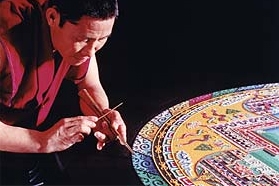
A special sand mandala painting is a gift to New York City from the Tibetan Buddhist monks of Drepung Loseling Monastery as a tolken of healing and goodwill following the terrorist act against the city on September 11, 2001. The construction of the mandala begins with a ceremony in which the monks consecrate the site and call forth forces of goodness through chants, meditation, and music. Then, over the course of ten days, the monks will pour millions of grains of colored sand from traditional metal funnels (chak-purs), purifying and healing the space and its inhabitants in the process. Shortly after its completion the monks will dismantle the mandala to symbolize the impermanence of all that exists and disperse the sand in order to share its blessing.
History and Geography
Siddhartha Gautama, the Buddha, was born in what is today Nepal in 563 B.C.E. While we know that his followers spread the message of Enlightenment after his death, the presence of Buddhist art is often the earliest proof of the existence of Buddhism in a given place.
The first traces of Buddhist art were produced in India during the first century B.C.E.
Buddhist missionaries transported doctrines from India along the Silk Road (through the Karakorum and Hindu Kush regions, Kashmir, parts of present day Pakistan, and northern Afghanistan) as early as the third century B.C.E.. Artifacts followed sometime after. Literary and archeological evidence indicate that Buddhism arrived in China by the first century C.E. From China, Buddhism reached Korea in the fourth century C.E. and from Korea it spread to Japan in the middle of the sixth century C.E.
By the first century C.E. Buddhism had reached various regions of southeast Asia and became particularly important in Indonesia during the seventh and eighth centuries C.E.
Buddhism reached Tibet (present-day Tibetan Autonomous Region, located in the South-West portion of China) in the seventh century C.E.
The Painters
The majority of painters, past and present, were pious laymen, usually from families whose hereditary occupation was painting. Some painters were monks. All painters were religiously minded, and in Tibetan Buddhism such painters were required to undergo certain initiation rites first. Paintings were commissioned by a patron.
Artists worked seated on the floor with the painting propped in their laps or in front of their crossed legs.
The Paintings
Paintings were created in a systematic way, proceeding through five steps:
-
Preparation of the Painting Surface
The most common support (the underlying material) was cloth stretched on a wooden frame. The cloth was sized by an application of gelatin to coat and stiffen it. Applied over the support was a ground, a top layer, of gesso (white earth pigment, either chalk or white clay). The gesso was polished to create a perfectly smooth surface. -
Establishment of a design by sketch of transfer
The patron indicated what was to be depicted. A diagram might be provided. Many compositions were fixed by Buddhist iconography and artistic tradition. These might be drawn from memory or according to standard examples. The preliminary sketch is made with charcoal crayon. The final drawing reinforced the sketch in brush and black ink. -
Laying down the initial coats of paint
Paints were of two types, mineral pigments and organic dyes. Brushes consisted of a tip of fine animal hairs attached to a wooden handle by a thread. Mineral pigments were mixed with a binder, usually hide glue, before being applied as paints. They were usually used for the first coat of colors. -
Shading and outlining
Organic dyes were used for shading and outlining. -
Finishing touches
Most painters finished the work by scraping the painting with a knife edge in order to create an even surface. The artist then dusted the painting with a duster or rag and rubbed the surface with a small ball of parched grain flour dough. This restored a matte finish and picked up any remaining paint dust. The last pigment laid down was gold.
Author: Nancy Blume.