Buddhism in China
Fojiao: the Teaching of Buddha, the Enlightened One
This is part of a series that examines Chinese belief systems: how people think and behave, philosophically and religiously. In understanding Chinese belief systems, it is important not to take terms at face value; the word "religion" (zongjiao), for example, did not exist in the Chinese lexicon until the 19th century. Appreciating the complexity of Chinese belief systesm is crucial to understanding the forces that helped shape China.
Buddhism, a cultural system of beliefs and practices based on principles of compassion and non-attachment, originated in the sixth century BCE in what is today Nepal. It was brought to China by Buddhist monks from India during the latter part of the Han dynasty (ca. 150 CE) and took over a century to become assimilated into Chinese culture.
One of the key forces of Buddhism’s success was Daoism. To help the Chinese comprehend Buddhist concepts, Buddhists borrowed ideas from Daoism via the Chinese language. Both Buddhism and Daoism benefited from this exchange. Daoists expanded their ideas about the cosmos and ways to structure their monastic orders. Buddhists gained a lexicon that made it easier to teach their tradition.
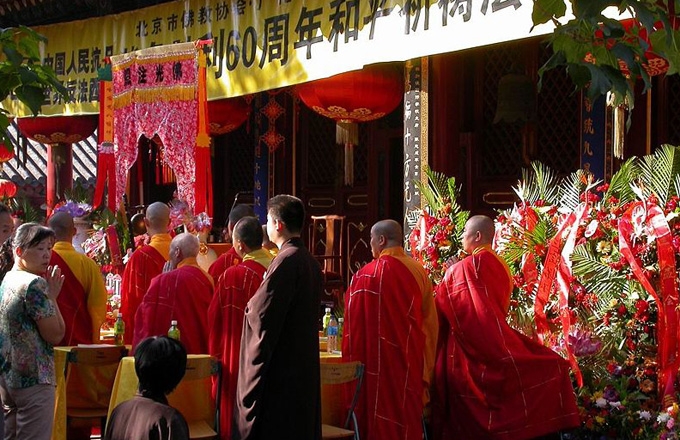
Over time Buddhism became a popular force in the lives of the Chinese, from the common people to the emperor himself. In fact, by the sixth century, Buddhism rivaled Daoism in popularity and political influence. It was during this time, and over the course of the next three centuries, that major schools of Chinese Buddhism formed. Two schools that retain their influence today are Pure Land Buddhism and Chan (Zen) Buddhism. Even in mainland China, where religion is often suppressed by the government, there are practitioners of these two schools of Chinese Buddhism.
Buddhism in China–as is the case with religious Daoism and Confucianism–also underwent many changes throughout the country’s history and was varied in its social and religious manifestations and philosophical beliefs. Most scholars think of Buddhism as many Buddhisms. In the so-called classical period of Buddhism in China (Tang dynasty, 618–907 CE), there were a number of schools of Buddhism that taught and promoted their own philosophies and meditation practices. The Huayen and Tiantai schools, for instance, varied in philosophy, location, and political influence. The teachings of various schools influenced and were adapted by Korea and Japan.
One of the most popular figures in Chinese Buddhism is the Bodhisattva Guanyin (the one who perceives the laments of the world–Guanshiyin). Having originated from Indian Buddhism as a superior being who aids the suffering of the world, Guanyin has become a key figure in the devotional practices of Chinese Buddhists and Daoists alike.
Author: Geoff Foy