
Pakistan in 2009: Crisis or Stability?
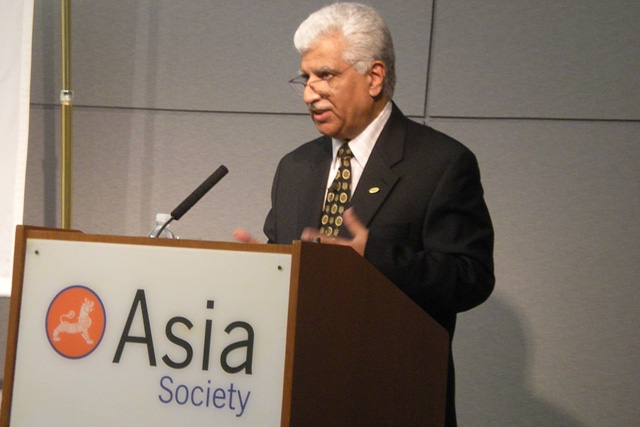
NEW YORK, November 12, 2008 - The escalation of violence and religious extremism in Pakistan is “making [the country] ungovernable," according to a senior policy analyst from Lahore. The changing demographic and massive “youth bulge” that Pakistan is experiencing is in part responsible for the increased violence over the past decade, which in turn has led to a shift in attention from welfare and development to security.
During this time of shaky transition in Pakistan, Saeed Shafqat, director of the Centre for Public Policy and Governance at Forman Christian University, Lahore, predicts that Pakistanis will continue to “struggle and oscillate between hope and despair” in the coming year. In a conversation moderated by Asia Society President Emeritus Ambassador Nicholas Platt, Shafqat discussed the emergence of Pakistani elites who "hold [socially and politically] conservative values that depict authoritarian tendencies rather than democratic [ones]."
Shafqat laid out three possible outcomes for Pakistan in 2009. The first option would be a “painful and slow transition to democracy” as political parties and international actors proceed with caution and prudence. The acceptance and acknowledgment of terrorism as an indigenous, internal problem is seen as the first step in the right direction. A second, more pessimistic route would see the Pakistan Peoples Party (PPP) and the Pakistan Muslim League Nawaz (PML-N) resort to “1990s-like” violence resulting in civil unrest. A third possibility would involve the spread of the Taliban throughout the North-West Frontier Province (NWFP), creating fear and prompting intervention form the outside world.
Shafqat is optimistic, however, that competent military influence and a proactive civil society will prevail and help lead Pakistan's transition to democracy, though not without some pressure from the international community.
Reported by Kyle Carroll
Excerpts:
On the status of inevitable IMF efforts in Pakistan: “Is the government negotiating skillfully enough?” (2 min., 32 sec.)
On government development of educational policies to address religious tolerance: “Unless we revive, energize, and renew public sector education, we are in deep trouble.” (3 min., 16 sec.)
Listen to the complete program (44 min., 51 sec.)