Attitudes Towards Nature in Daoist Art
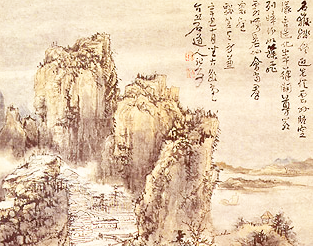
Materials:
- Paper and pencils, crayons or paints
- Slides or prints of several Chinese landscape paintings.
The Bible's Old Testament tells us that man has dominion over the rest of creation, and the 8th Psalm, echoing a similar attitude, states that the Lord made man "a little lower than the angels," and, "Thou madest him to have dominion over the works of thy hands and has out all things under his feet." Chinese art, particularly landscape paintings, suggest a very different relationship between humans and nature. Daoists speak of a harmony among all aspects of nature, and say "Heaven and earth and I live together." The harmony in nature is illustrated in the balance between such things as water and mountains. Waterfalls and mountain peaks make up much of Chinese landscape painting, and people seeking to understand the secrets of the power of nature, the Dao, often contemplate those paintings when they cannot go the countryside and view an actual mountain or waterfall. In many, if not most, landscape paintings, humans have a place. They are participants in the natural scene, but they do not dominate it. This exercise should be part of a larger lesson on Daoism in the Middle Kingdom. It could be included in a history or art history class and be used either to illustrate what the students have learned about Daoism or to introduce some Taoist values.
Objectives:
Through this activity, students will be able to:
- appreciate what some Daoists suggest is the harmonious relationship between humans and nature
- compare Daoist attitudes about nature with some Chinese attitudes
Teaching Time:
One class period.
Procedure:
Tell the class you want them to make an illustration of a fisherman in a mountain stream.
Then read them the following poem.
Snow on the RiverHave each student make an illustration of the poem. This assignment is perhaps best given as homework.
Over thousand of mountains, no bird flies
Over thousands of paths there is no trail off footprints.
On a lonely boat sits an old man with bamboo hat and cape,
Fishing silently in the snowy river.
--Liu Zongyuan (773-819)
Students should share their illustrations of the poem. Some students may have concentrated on the fisherman and forgotten to include the mountains or cloudless sky. Discuss with their illustrations.
Look at several landscape paintings. Ask students what these paintings suggest about the relationship between humans and nature. How do the paintings reflect what they know about Daoist attitudes? How might Chinese artists have illustrated the poem?
Have the students draw another illustration so that the fisherman no longer dominates the picture. Have students share their illustrations with one another. What attitude toward nature does their second set of illustrations suggest?
Give students the following poem and have them discuss it . What is the poet's attitude toward the troops? Toward the mountain? Now ask students to make a "Dao-like" illustration of this poem.
A Distant View of Zhongnan Mountains
The snow has gone from Zhongnan; spring has almost come.
Lovely is the distance its blue color against the brown of the street.
A thousand coaches, ten thousand horsemen pass down Nine Roads;
Turns his head and looks at the mountain, not one man!
--Bai Juyi (772-846)