Buddhism in Japan
Buddhism is a religion that offers a spiritual path for transcending the suffering of existence. Samsara, the endless cycle of birth, death and rebirth to which all beings are subject, results from the consequences incurred by oneʼs karma, the sum of good and bad actions that accumulates over many lives. Release from this endless cycle is achieved only by attaining enlightenment, the goal for which Buddhists strive. A buddha (“enlightened one”) is an all-knowing being who has reached that perfect state of transcendent knowledge in which the fires of greed, hate, and delusion are quenched and, upon passing into nirvana (“blowing out, to become extinguished”), is never subject to rebirth again.
According to tradition, the founder of Buddhism was born in 563 B.C.E. in the region that is now southern Nepal. He was born a prince, named Siddhartha (“he who achieves his goal”) and also known as Shakyamuni (“sage of the Shakya clan”). Siddhartha left his palace, renouncing his princely life, and set out to find the cause of human suffering. He became a wandering monk. After years of searching, he found his answer—his awakening—and proceeded to teach others. When he died, he attained nirvana, the final release from earthly suffering, and became the Buddha (“the awakened or enlightened one”). After his death, the Buddha's teachings were written down by his followers who spread his message. These texts are called sutras. An organized religion began to take form, and with time new branches of Buddhism emerged.
Three main types of Buddhism have developed over its long history, each with its own characteristics and spiritual ideals. Theravada or foundational Buddhism, the earliest of the three, emphasizes the attainment of salvation for oneself alone and the necessity of monastic life in order to attain spiritual release. Mahayana (“Greater Vehicle”), whose members believe that the adherents of Theravada pursued a path that could not be followed by the majority of ordinary people, teaches that all can attain salvation. Practitioners of Vajrayana (“Diamond Vehicle”), or Esoteric Buddhism, believe that one can achieve enlightenment in a single lifetime. These three schools are not mutually exclusive but emphasize different practices. For example, while Theravada teaches that only a few devotees are able to reach enlightenment and that they do it alone, Mahayana and its later offshoot, Vajrayana, teach that enlightenment is attainable by everyone with help from buddhas and beings known as bodhisattvas (those who have attained enlightenment but remain on earth to assist others on their paths).
A major, long-established East Asian route of trade and influence ran from northern China through the Korean peninsula and across the Korean Straits to Japan. Traveling along this route, Mahayana Buddhism was introduced to Japan from Korea in the sixth century (traditionally, in either 538 or 552, as part of a diplomatic mission that included gifts such as an image of Shakyamuni Buddha and several volumes of Buddhist text). As in Korea, the religion had a lasting effect on the native culture. By the seventh century, when the religion was firmly established, Japan had dozens of temple complexes, various orders of priests, and a body of skilled artisans to craft the icons and other accoutrements that the practice of the faith required.
Vajrayana or Esoteric Buddhist and its attendant pantheon of deities and secret, mystical rituals, was introduced to Japan in the early Heian period (after 794) by a number of Japanese priests. They studied the religion in China and returned home to found influential monasteries, two of which became the centers of the main Japanese Buddhist sects, Tendai and Shingon. Images of wrathful deities, such as Fudo Myo-o (Achala in Sanskrit), were introduced at this time as part of the Esoteric Buddhist pantheon.
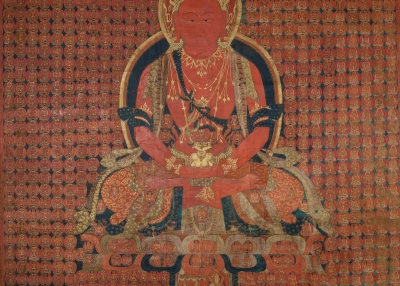
In the late Heian period (until 1185) and following centuries, Pure Land Buddhism became very popular. The salvationist Pure Land Buddhism taught faith in Amida (Amitabha in Sanskrit), the buddha of the Western Paradise. Believers trusted that the diligent recitation of his name enabled the soul to be reborn in a heavenly Pure Land rather than in a Buddhist hell or other undesirable rebirth. Intense devotion to Amida produced voluminous requests for Buddhist statuary and paintings, in addition to the many temples dedicated to him. Another salvationist deity popular at this time was Jizo, who had been introduced to Japan centuries earlier as a bodhisattva in the Mahayana Buddhist pantheon.
Jizo is a deity of compassion and benevolence whose attributed powers expanded as time passed. During the Kamakura period (1185–1333), Buddhism became the faith of all people of all classes. This was due in part to the many priests who became itinerant evangelists and brought Pure Land Buddhism to the masses.
Buddhism
Zen is the Japanese development of the school of Mahayana Buddhism that originated in China as Chan Buddhism. While Zen practitioners trace their beliefs to India, its emphasis on the possibility of sudden enlightenment and a close connection with nature derive from Chinese influences. Chan and Zen, which mean “meditation,” emphasize individual meditative practice to achieve self-realization and, thereby, enlightenment. Rather than rely on powerful deities, Zen stresses the importance of the role of a teacher, with whom a disciple has a heart-mind connection. This allows the teacher to offer the student helpful assistance in his spiritual development. Zen also values intuition instead of habitual, logical thinking and developed expressionistic and suggestive (rather than explicit and descriptive) painting styles and poetic forms as well as illogical conundrums (koan) to stimulate one' intuition. While Zen was first introduced into Japan several centuries earlier, it did not become firmly established until the thirteenth century, when the warrior class began to favor this school of thought.
Buddhist Imagery
In India several hundred years after the time of Shakyamuni, Buddhism developed a rich tradition of visual imagery for depicting sacred beings. Based on descriptions recorded in the scriptures, buddhas are typically shown as human figures with supranatural attributes to represent their spiritually elevated status. The most commonly depicted bodily markings include a bump on the top of the head to indicate wisdom (ushnisha in Sanskrit), a mark in the middle of the forehead that also shows great understanding (urna), elongated earlobes that are a reminder of Shakyamuni's princely youth (young royals wore large earrings in his day), and a body with idealized proportions and contours. In addition, buddhas are often, although not always, shown as ascetics who wear simple monastic robes and are devoid of decorative shawls, scarves, and jewelry. Bodhisattvas, on the other hand, are customarily shown richly ornamented, representing their continued engagement with this world. Buddhist icons offer messages or information to viewers through their hand gestures (mudra). Common gestures include the ones for meditation, teaching, and assuaging fear/wish-fulfilling.
The appearance of Buddhist imagery varies according to when the object was made, contemporary and local stylistic preferences, the materials used and skill of the craftsmen, and religious requirements. Whereas Zen-related representations often are relatively austere, encourage a contemplative attitude, and can be closely linked to Chinese prototypes, icons associated with the court-supported temples of the Esoteric schools can have multiple arms and heads to express great power and superhuman abilities and be richly ornamented with sumptuous materials and complex layers of decorative patterning.
Author: Elizabeth Hammer.