Discuss: Are Indian Business Innovations Relevant to the West?
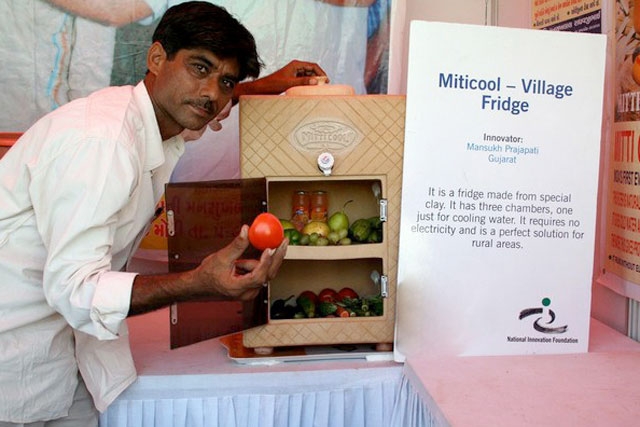
Indian inventor Mansukhbhai Prajapati poses with his ‘Mitticool (mud cool) Village Fridge’ in Ahmedabad. (Blood Orange Media)

Indian inventor Mansukhbhai Prajapati poses with his ‘Mitticool (mud cool) Village Fridge’ in Ahmedabad. (Blood Orange Media)

India is emerging from the global recession as a source for low cost services and products in the fields of technology, business, energy, healthcare and education. In contrast to the West, India is full of entrepreneural spirit and drive, and its innovators are determined to make their products available to general public. 

The first in a series on Asian Innovation, Asia Society will host discussions in San Francisco and New York with these trailblazing Indian entrepreneurs. Find out more about them at INDOvations.

Can India help the US rediscover its entrepreneurial spirit and drive? How relevant are Indian innovations to the West, especially in times of crisis? Join the discussion below.

Related links
Business Week article on global trends in innovation
Business Week article on jugaad, "India's improvisational style of invention"
Harvard Business Review blog post, 1/25/10


i like it very much.

Great article and I am looking forward to seeing the Indique series. How is jugaad different from frugal engineering or from simple creativity? Is jugaad just a fad? Is it a legitimate business process or model for business today? How does the process of jugaad work? What are the steps businesses should take?
Surely,they are very much relevent to the west. As it happened earlier also from the vedic ages, it is indians who'd invented everything like physics, math, geometry,medicine and later developed by west. But times has changed and now india can invent new technologies and market them also ( unlike china which masters in copying whatever technology is available).
Navi, Are there parallels to jugaad in other emerging-market nations? For instance, is there a Brazilian or Chinese style of frugal innovation that you have been researching for context? Best, Reena Jana
Hi Reena: Yes, we have looked at the innovations happening in China and we also find entrepreneurs (especially in Tier 2/3 cities) in China applying Jugaad principles (i.e., frugality, inclusiveness, collaboration, flexibility) to deliver more value at less cost for more people. Last year, the Centre for India & Global Business hosted a conference titled "How to Create Value from Emerging Markets" where we compared Indian and China innovations (I guess we can call them Chinnovations!!): http://www.india.jbs.cam.ac.uk/news/events/2009/090518_innovation/index.html (once you register you can access all conference proceedings) We haven't looked into Brazilian case studies yet, but it appears that they also have a word similar to Jugaad: jeitinho brasileiro. Worth checking that out!
The Financial Times just published an article on Indian Innovation that highlights how notable is the drive to find adaptable products for the Indian mass market and provides several examples. Here is the the article: http://www.ft.com/cms/s/0/eac60c1c-0518-11df-aa2c-00144feabdc0.html?nclick_check=1
One thought here... the title of the talk centers around the question of if Indian innovations are applicable or relevant to the West. Here is a different way to think about it- Western high consumer culture may look down on simple inexpensive innovations made from insight and creativity in the lives of poor people in India. Perhaps some of those innovations are out of context for us. But maybe the West is not the final destination of these innovations - a question I would like to see addressed which I think is extremely important is: Are Indian innovation relevant in other parts of the world? Specifically other countries and communities in the developing world. What innovations have people come up with in India for inexpensive refrigeration that may also be useful in Uganda, in Indonesia, in Argentina? I challenge people to use this as a time to think outside the western box, linking one community to another to share innovations that may seem obsolete or out of context for us, but invaluable in other contexts.
Dear Suzanna: You are absolutely right that many Indian innovations boast strong relevance for other emerging markets. That's why companies like Unilever, PepsiCo, GE, Whirlpool are replicating India-inspired innovations across other emerging markets. For instance, PepsiCo India developed Nimbooz, a lemonade drink without fizz or artificial flavors, which has become a big hit in India. PepsiCo leveraged the idea and technology behind this 100% natural product to launch Mirinda Karkedeh in Egypt which is based a hibiscus-based drink. However, I do believe that several India-inspired innovations will eventually find their way into the US simply because post-recession the "high consumer culture" you were referring to is morphing into a "value-focused, frugal consumer culture" which is seeking affordable yet high-value goods and services. That's already happening in the car industry: US consumers are shunning expensive gas-hungry cars in favor of small, fuel-efficient vehicles. Unfortunately, here is the sad statistic: if you look at the list of top 10 global players with a meaningful strategy for developing small cars, you won't find any of the Big 3 US car makers. So invariably, we are going to see small cars like NANO inspired/designed/made in emerging markets like India finding their way into the US to meet American consumers' growing need for compact, energy-efficient cars. Finally, here are 2 statistics that baffle me: the US is home 50 million Americans without health insurance and 106 million citizens who are underbanked. Imagine how these US segments can benefit from low-cost healthcare solutions like telemedicine and financial solutions like mobile payment schemes that have been successfuly deployed in India. Here is a blog I wrote on how mobile payment solutions such as Obopay.com can tremendously benefit the US too: http://blogs.harvardbusiness.org/radjou/2009/10/mobile-bankings-next-big-market.html
Hi Navi, I have been following the discussion with some interest and wanted to ask a question pertaining to the network effects that exist between entreprenuers in Silicon Valley and entrepreneurs in India. We see in Silicon Valley what is called the 'cluster' effect - schools that train IT professionals, companies that set up their HQ in silicon Valley and the flocking of professionals to this area and a proliferation of VC funds that then scope out ideas to invest in. To some extent the same phenomenon was also seen in Banglaore which encouraged the IT outsourcing industry to flock to this region. To what extent do you think this was driven by Indian innovation? Do you see any possibility of a cluster type phenomena occuring in any other industry in India? To what extent would this be influenced by innovation? Thanks!
Hi Navi, Interesting take on the concept of 'jugaad' - what really fascinates me is how people with contrained resources manage to imagine ways to circumvent their limitations. My question is more specifically focused on the "Indian nature" of the innovations. Is there an inherently 'Indian way' of innovating? If so, what are the unique attributes of this model? How is it different from the models adopted elsewhere in the subcontinent or the world for that matter? Looking forward to attending the program and especially to see the examples of Indian innovation.

Post new comment

Your comments are welcome, please adhere to our guidelines

Be respectful. Personal attacks will not be tolerated; nor will profane, abusive or threatening posts.

Keep it short (150 words or less), Stay on topic.

Asia Society reserves the right to moderate all comments and remove or edit for guideline violations. Thank you.

The content of this field is kept private and will not be shown publicly.
Type the characters you see in this picture. (verify using audio)
Type the characters you see in the picture above; if you can't read them, submit the form and a new image will be generated. Not case sensitive.