Use Technology to Develop Global Competence

(retrorocket/istockphoto)

(retrorocket/istockphoto)

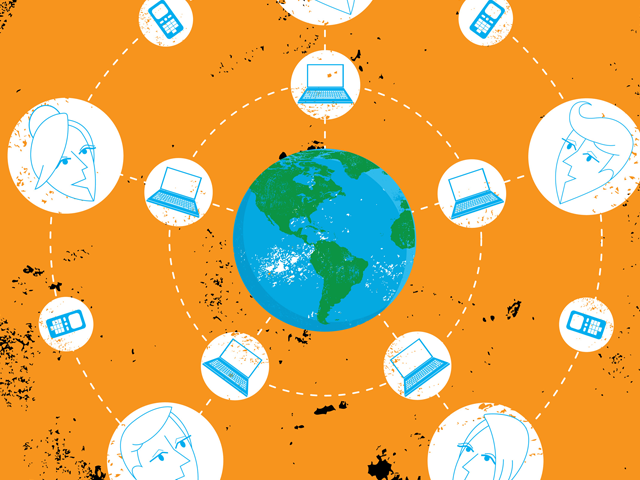
Computers, video conferencing, computer games, online courses, blogs, video-sharing Web sites, smart phones, Web 2.0 tools, help connect our world like never before. They have bridged distances and increased our opportunities to learn from each other: to see new places, meet new people, explore other cultures, learn new languages, and share and develop ideas. Bringing the world into the classroom has never been faster, easier, or more motivating for teachers and students.

Educators agree on two key points. First, technology provides vital tools for twenty-first-century learning. Also, today’s students are indisputably motivated by technology. Digital devices are already familiar gateways to the world for today’s students. Used thoughtfully, these technologies can give students meaningful connections to people, places, and issues far beyond their own neighborhood.

How can different digital tools and formats be used to promote global learning within content standards for accountability? These technologies should not be considered a supplement for existing curricula, nor should they be limited to technology training courses. Instead, they can be used to help teachers meet their global learning goals across multiple curricular areas. Technology-based projects can be easily aligned to district and state standards.

A highly qualified professional in the knowledge economy requires the ability to pose critical questions and develop defensible responses to complex challenges. In developing these skills, teachers and students can tap a host of digital technologies. Locating and manipulating information online, collaborating in virtual work teams, and presenting and publishing via digital platforms is preparation for the future in a world that increasingly runs on technology.

Investigate the World

Digital technologies can help students investigate their world in many classes and curricular areas. A case in point is Google Earth, which is changing the face of geography, history, and science instruction. Students can investigate regions via satellite views or get street-level views of a specific location. Real-time views of ancient sites in Turkey or new construction in Hong Kong via Google Earth enlivens the study of places beyond the classroom in ways that photos and, in some cases, even video can’t match.

Randolph Elementary School in Arlington, Virginia, has a very diverse student population. Connecting to cultures that originate thousands of miles away can be challenging, but Randolph’s teachers turn to digital technologies to bridge the divide. They use Google Earth to discover the ancestral homes of students new to the United States and those whose families have been here for generations, as they study family histories in their curriculum. Lessons with this kind of personal association motivate students more than simply reading about cultures here or abroad.

Recognize and Weigh Perspectives

Globally competent students are able to weigh their own perspectives and those of others and also against the perspectives that data, science, and history offers. Students can also understand and articulate the differences between these points of view. One exciting way to provide such experiences is through digital technologies, which have been a major force in providing extended opportunities for global exploration, learning, and reflection. These technologies are especially valuable to students who don't have the opportunity to travel. Virtual worlds immerse young learners in a new environment and encourage exploration. Panwapa, for example, is an online virtual world created just for children, in the preschool and primary grades, by Sesame Workshop. Its Muppet characters have a familiar look and activities are designed specifically to help four- through seven-year-olds build respect and empathy for others, to spark an interest in other languages and global learning, and to develop a sense of responsibility as global citizens. Children join this virtual community and create their own avatar, select their home country, and even design a flag for it.

Third graders at Sugar Creek Elementary School in Verona, Wisconsin, have begun a virtual partnership with Morland Primary School in Ipswich, England. Students on both sides of the Atlantic share a Web site where they post photos and joint assignments. They have shared haiku, New Year’s resolutions, and videos in which they introduce themselves.

Online networks foster global perspectives among students by connecting them directly to peers around the world through collaborative learning projects. One of the most popular is the International Education and Resource Network (iEARN). This non-profit organization connects classrooms around the world via the Internet and other digital technologies. Classrooms work together on projects that meet learning objectives and have an impact on issues that affect students in all nations.

Communicate Ideas

Communicating ideas with peers in other countries is an important way to build global understandings. Clyde Erwin Elementary Magnet School in Jacksonville, North Carolina, connects with its sister school in Puebla, Mexico, through Elluminate, a Web conferencing program that also uses an interactive white board. Staff members won a grant to help Clyde Erwin students and their counterparts in Puebla collaborate on a book-authoring and -publishing project. They collaboratively published a book about “Canela” and “Erwin,” two teddy bears (one from each school) who visited each other’s country and had interesting adventures. The book was published in both English and Spanish. This type of collaborative learning works to foster cultural understandings as well as global content.

Using digital connections to communicate with native speakers, especially other students, is revolutionizing language learning. Students today can easily connect with their peers in another country, practice language skills with native speakers, see classrooms in other nations, and make a human connection with someone across the world.

As an Instructional Supervisor with the Pennsylvania Cyber Charter School, the Asian Society Criteria are something I see some of my students engaged in on a daily basis, albeit on a micro scale. Cyber education, particularly synchronous cyber education as practiced by PA Cyber, brings together students from across the State of Pennsylvania representing a wide and diverse variety of social, economic, and cultural backgrounds. Our students are provided with an opportunity to investigate the differences that may exist within a class, an opportunity to recognize and weight different perspectives, and the ability to communicate ideas in real time. Expanding that ability to a more global perspective would appear to be a simple matter of utilizing the resources we already have in place on a grander scale. The key to successful implementation of such an effort will rest, however, on the extent to which a human element can be incorporated. What connects culture is the human element; students have had access to books, films, and videos detailing other cultures for decades. But only recently, have students had the ready capability to directly interact, in real time, with multiple cultures on a global basis. By utilizing collaborative tools such as ePals and Skype, teachers and students have an unprecedented opportunity to add a dimension to global education that will lend depth and added relevance to lessons. With a subscription to ePals, students can, “promote cross-cultural collaborations such as foreign language learning, foster class-to-class projects on diverse subjects, and swap inspiring ideas with schools and teachers from around the globe” (ePals, 2011). Skype, and similar web platforms, can also help to foster a better global understanding, as well as, help to prepare students for what will almost certainly be a common element of future 21st Century learning.
ePals. Retrieved from http://www.epals.com/groups/about/pages/epals-overview.aspx, 9/4/2011.
Skype. Retrieved from http://education.skype.com/, 9/4/2011.

As an Instructional Supervisor with the Pennsylvania Cyber Charter School, the Asian Society Criteria are something I see some of my students engaged in on a daily basis, albeit on a micro scale. Cyber education, particularly synchronous cyber education as practiced by PA Cyber, brings together students from across the State of Pennsylvania representing a wide and diverse variety of social, economic, and cultural backgrounds. Our students are provided with an opportunity to investigate the differences that may exist within a class, an opportunity to recognize and weight different perspectives, and the ability to communicate ideas in real time. Expanding that ability to a more global perspective would appear to be a simple matter of utilizing the resources we already have in place on a grander scale. The key to successful implementation of such an effort will rest, however, on the extent to which a human element can be incorporated. What connects culture is the human element; students have had access to books, films, and videos detailing other cultures for decades. But only recently, have students had the ready capability to directly interact, in real time, with multiple cultures on a global basis. By utilizing collaborative tools such as ePals and Skype, teachers and students have an unprecedented opportunity to add a dimension to global education that will lend depth and added relevance to lessons. With a subscription to ePals, students can, “promote cross-cultural collaborations such as foreign language learning, foster class-to-class projects on diverse subjects, and swap inspiring ideas with schools and teachers from around the globe” (ePals, 2011). Skype, and similar web platforms, can also help to foster a better global understanding, as well as, help to prepare students for what will almost certainly be a common element of future 21st Century learning.
ePals. Retrieved from http://www.epals.com/groups/about/pages/epals-overview.aspx, 9/4/2011.
Skype. Retrieved from http://education.skype.com/, 9/4/2011.

Asiasociety.org explains that globally competent students and teachers use technology to investigate the world, recognize and weigh perspectives, and communicate ideas. I feel it is important to note that it is teachers also, because students can only become globally competent if the teachers are as well. And yes, technologies can certainly help those in education with the 3 areas this blog mentions. Google Earth is one tool mentioned, but there are also websites that can be found that have real-time cameras that stream live feeds 24/7 of different parts of the world. Another very useful tool when it comes to investigating the world, and that is one of many examples. This blog also mentions collaborative projects with students and classes from other parts of the world. I think it is important to take advantage of these unique learning opportunities. Students stand to learn a great deal about perspective when they see how two very different classrooms approach the same task. Finally, the Asia Society mentions the importance that communication has. I could not agree more, and technology has definitely offered more ways to communicate with those across the globe. Messaging and video conferencing services like Skype jump to mind first. But there are more that can connect classrooms. Also, blogs and websites allow for communication across cultures, just not necessarily in real time.

All of these tools mentioned and more can be useful to a 21st century classroom. However, how useful they are is limited by the creativity and motivation of the teacher to incorporate such ideas into the curriculum. Teachers needs educated on many of these tools and how to use them as much as students do in many cases. A globally competent school would make these ideas a focus of more professional development.

The Asian Society criteria are that:
1.Students need to investigate the world, 2. Recognize and weigh perspectives 3. Communicate ideas.
The use of internet and mobile devices have allowed for these criterion to be met easily. Students can use Skype or Facetime chat to interact face to face and build knowledge of their surroundings. Also the traditional boundaries of geographical location no longer limit the learning experience. Students can connect anytime, anywhere to communicate or learn. Now students can speak with people in different cultures, learn new languages and consult with authorities on basically any subject area.

It's amazing what technology has done in the classrooms. Students from the U.S., Canada and from countries on the other side of the world can all communicate via the Internet. By using Skype, chat rooms, Elluminate and other online digital tools, students can interact with students from various backgrounds and cultures. In this way, they are not only reading about China, Candada, Japan or the U.S. in a book, they are deepening their knowledge and they're able to ask questions and learn the language. This helps all students to better understand globalization and some of the similarities and differences we all share. Online programs like Google Earth and virtual field trips can also help students to gain perspective of the world and the people in it. In the video, Chinese Education-Social Life and Work Ethic,(2009), it was interesting that the teachers video tape all of their lessons for the other teachers to watch and critique. I remember doing that for my student teaching, but it's not something that is typically done on a daily basis. I could see how this could benefit newer teachers, and maybe even veteran teachers.
China already has their entire curriculum online. In the next 10 years they want to have 100 million online students k-12. The US has increasingly more and more online schools popping up and the enrollment continues to increase. "Brick and mortar" schools are incorporating more technology and online classes into their curriculum. Technology in education is the way of the world today and it continues to grow and will be even more involved with newer technologies as time goes on.
References:
Bullitt, L., Cromack, K., Kidd, A., & Kline, J. (Producer). (2009).
Chinese education-social life
and work ethic. [Web]. Retrieved from
http://vimeo.com/10293179

Americans are becoming less and less globalized. Their global awareness is shrinking and they are becoming more centralized in their thinking in regards to the world. Many students do not know about the United States in relation to other countries. Kate Berseth, vice president for strategic marketing and partnerships at EF Education, expresses her concern about the narrowing view of the globe as Americans. She is a large advocate for global awareness and she believes schools are not doing their part in properly preparing students to be globally aware. Even with having access to programs such as Google Earth as mentioned in the Investigate the World section, students are still ill-prepared when it comes to geographic awareness and global literacy. The internet has broken down many of the barriers that have separated states and countries in the past. Communication and information is at everyone’s fingertips if they have access to the internet. It is mind boggling to then hear such data stating how ill-informed people are. Teachers and even parents need to take charge and make global literacy a priority. Even though social studies lesson time has been cut significantly in the past few years, teachers need to focus on current events in the world and place a major focus on where the event is happening and how it potentially relates to the US. This is the only way students will gain a better appreciation for the world around them.

McCloskey, M. (Host). (2008, November 6). Developing Students’ Global Understanding [Podcast]. The Whole Child Podcast: Changing the Conversation about Education. Retrieved September 2, 2011 from http://whatworks.wholechildeducation.org/podcast/page/4/ .

Madeline Greene wrote in America.gov (Bureau of International Information Programs, 2008)
that American students need to learn more about foreign affairs, and also become more proficient in foreign languages. I think that the above technologies and ideas on how to use these technologies are just what all schools should be using to help change this academic deficiency.
Bureau of International Information Programs. (2008, July 18). Globalization's Impact on U.S. Education. Retrieved 09 4, 2011, from America.gov: http://www.america.gov/st/texttrans-english/2008/July/20100831132512nero...

In her article, “The Challenge of Global Citizenship in our Schools,” Bambi Betts says that global citizenship encompasses three ideas and a school needs to be committed to these three principles in order to teach students how to be a global citizen.
4. Mankind is essentially one family
5. Unity is essential and it will generate from diversity
6. There is no place for prejudice of any type.
Using technology is one way of aiding global citizenship and competencies. The use of technology opens students to limitless possibilities to learn and explore other cultures and ways of view. Technology can be a powerful tool to help students investigate the world, recognize and weigh perspectives, and communicate ideas. Technology gives students the ability to be linked with other students around the globe and to communicate and share ideas with these students. Technology also allows students to look up and learn virtually anything about another culture, thus making them aware of the uniqueness of others. This also brings students out of their little “bubble” and shows them that differences among people groups is part of what makes this world so beautiful. If students never explore these differences there can become a tendency to think that “my way is the best way” and that anyone who thinks differently is inferior. The break-down of that narrow minded way of thinking is key if students are to become globally competent. Being educated about other cultures must occur in order for students to truly appreciate the differences between people groups and technology is one very good conduit for educating students and for connecting them with others around our world.
Betts, Bambi (Retrieved 9/3/2011). The Challenge of Global Citizenship in our Schools [On-line].
Available: https://franciscan.blackboard.com/bbcswebdav/courses/EDU541OLAug2011-C/G...

The article Use Technology to Develop Global Competence discusses many aspects of utilizing technology to connect students around the world. Through various portals and programs, students today are able to share cutural and educational tools to help create a global community. There area many organizations that I have come across that are dedicated to promoting global trends within education. The Center for Global Education promotes international education to foster cross-cultural awareness, cooperation and understanding. Living and working effectively in a global society requires learning with and international perspective. (retrieved 9/4/2011) Using programs such as elluminate (as mentioned in the article above) allow students to connect with one another eliminating the distance barrier that once existed.
source: http://globaled.us/

The three criteria that the Asia Society defines for global competence are to Investigate the World, Recognize and Weigh Perspectives, and Communicate Ideas. While incorporating these ideas for distance learning, it is important to also remember that global citizens in general believe that mankind is one society, unity is essential and will generate from diversity and that there is no place for prejudice (Betts, 2011). As the Asia Society has shown, students are able to investigate the world through multiple online sites that give them access to almost unlimited amounts information and numerous ways of interacting with one another. Some K-12 schools are now beginning to add secondary language courses to their online selections. The courses are taught with video using native speakers from multiple locations such as Paris, Madrid, Senegal, and Buenos Aires (Kisch, 2010). The online option is now going to be offered so that students are able to learn another language from someone living in an area where is it considered a native language. Students are now able to recognize and weigh perspectives in areas and issues that affect many societies around the world by enabling student’s better access to information and resources. As an example, the establishment of the Asia Society’s College of Staten Island High School for International Studies is a high-achievement high school that allows students to participate in college level activities during their high school years (Kisch, 2010). The school even requires that students complete 120 hours of participating in a cause of their choice, which include topics such as AIDS, child soldiers, and human trafficing (Kisch, 2010). These topics have a wide range and allow students to view what sitiations other students around the world might face. Students can also communicate ideas with one another easier than ever before. Communication is no longer just limited to inside the classroom but has encompassed the entire world. The Walter Payton College Prep School in Chicago connects with schools all around the world to find resources, seek out partnerships, locate sister schools and build cultural, economic and business relationships (Kisch, 2010). These students engage in activities that allow them to communicate and collaborate with one another even when they are located in different parts of the world.

References

Betts, B. (2011). The challenge of global citizenship in our schools. Retrieved September 2, 2011, from BlackBoard: https://franciscan.blackboard.com/bbcswebdav/courses/EDU541OLAug2011-C/G...

Kisch, M. (Sep-Oct, 2010). Opening young eyes. International Educator , 23-30.

Post new comment

Your comments are welcome, please adhere to our guidelines

Be respectful. Personal attacks will not be tolerated; nor will profane, abusive or threatening posts.

Keep it short (150 words or less), Stay on topic.

Asia Society reserves the right to moderate all comments and remove or edit for guideline violations. Thank you.

The content of this field is kept private and will not be shown publicly.
Type the characters you see in this picture. (verify using audio)
Type the characters you see in the picture above; if you can't read them, submit the form and a new image will be generated. Not case sensitive.