
Jati: The Caste System in India

Travelers to India have commented on caste for more than two thousand years. In Indian society the group comes first, unlike our own society that gives so much importance to the individual personality. After a person’s family, the caste commands an individual’s major loyalty. Indians still often identify themselves by the community they belong to and caste is still a factor in marriage selection. In addition, caste has allowed countless groups that have migrated into India to find a place and to play an important role.
Asia Society in India
Learn More
The caste system, as it actually works in India is called jati. The term jati appears in almost all Indian languages and is related to the idea of lineage or kinship group. There are perhaps more than 3000 jatis in India and there is no one all-Indian system of ranking them in order of status. Yet in each local area jati ranking exists and is very much related to purity and pollution. Each jati has some unique job, but not everyone in the jati performs it. Thus there are barbers who do not shave, carpenters who do not build, and Brahmins who do not act as priests. A jati is identified in a local setting by whom its members will accept food and water from and to which jatis its members will give food and water. People will try to marry their sons and daughters to members of their same jati and will give their major loyalty to their jati. A jati will usually be organized into a biradari (a brotherhood), and this organization carries out the business and oversees the working of the jati and has the power to exclude an offender from the jati.
The jati system is not static in which all groups stay in the same position. There is mobility in the system and jatis have changed their position over the centuries of Indian history. However, the jati moves up the social scale as a group and not as individuals. A jati can improve its position in the class system by advancing economically and emulating social groups with money and power. At the same time, a jati can also move up in the caste hierarchy. Mobility in the caste system has been termed “Sanskritization” by the scholar M.N. Srinivas. To gain position in this process, a lower jati copies the habits and behavior patterns of the dominant jati in the area. This may mean a lower jati will change its name to one of a higher jati, adopt vegetarianism, observe more orthodox religious practices, build a temple, and treat its women in a more conservative way. The type of emulation will depend on the habits of the dominant jati being copied. If the jati can gain acceptance for its new name, new history, and new status, it will then marry its daughters to members of the jati in which it is seeking to gain membership. In due time the new position on the social scale will be solidified and accepted by other jatis. This practice is not totally unlike that of immigrant groups coming to America and copying the habits of the WASPs who were in control. In your own community you could probably identify the most prestigious group of people and observe other members of the community copying their behavior in ways such as sending their children to dancing classes and summer camps, and putting braces on their teeth.
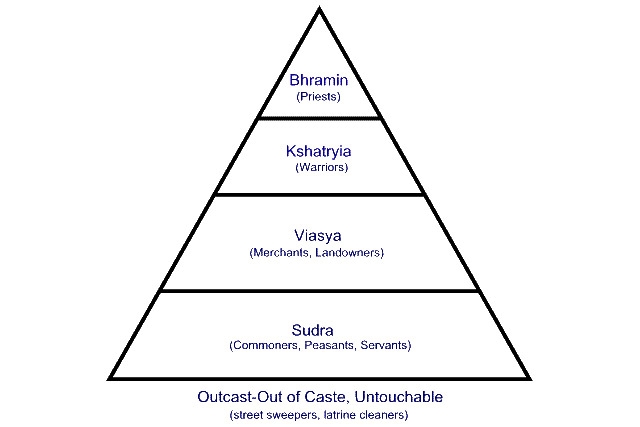
The Indian Constitution has outlawed the practice of Untouchability and the Indian Government has established special quotas in schools and Parliament to aid the lowest jatis. Caste discrimination is not permitted in gaining employment and access to educational and other opportunities. But this does not mean that caste is illegal or has faded away. Caste groups as political pressure groups work very well in a democratic system. Caste may provide psychological support that people seem to need. Economists and political scientists are finding that caste is no real barrier to economic development or political democracy.
Authors: Donald Johnson, Jean Johnson.
Discover More About India

Looking for More?
Discover Asia

Discover dynamic educational content for youth and families focused on Asian cultures and global learning.
Thank You for Reading!
If you’d like to support creating more resources like this please consider donating or becoming a member.