Japanese History
A Timeline
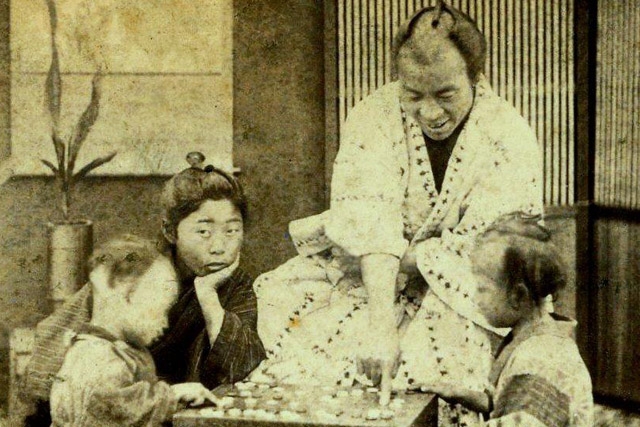
Note: Many dates are approximate. Some developments emerged over a period of years, and precise dates for events before A.D. 600 have not been determined. Notice how long the prehistorical era was compared to other periods.
JOMON (10,000 - 300 B.C.) Prehistoric period of tribal/clan organization.
Stone Age hunters and gatherers who make jomon (rope-patterned) pottery inhabit Japan. 660 B.C. Mythological Jimmu ("Divine Warrior"), descendant of sun goddess Amaterasu Omikami, founds empire.
YAYOI (300 B.C. - A.D. 300) Rice cultivation, metalworking, and the potter's wheel are introduced from China and Korea. Era named "Yayoi" after the place in Tokyo where wheel-turned pottery was found.
In Shinto, Japan's oldest religion, people identify kami (divine forces) in nature and in such human virtues as loyalty and wisdom. 100-300: Local clans form small political units.
KOFUN (YAMATO) (300 - 645) Unified state begins with emergence of powerful clan rulers; Japan establishes close contacts with mainland Asia.
Clan rulers are buried in kofun (large tomb mounds), surrounded by haniwa (clay sculptures). Yamato clan rulers, claiming descent from Amaterasu Omikami, begin the imperial dynasty that continues to occupy the throne today. Japan adopts Chinese written characters. Shotoku Taishi (574-622) begins to shape Japanese society and government more after the pattern of China. He seeks centralization of government and a bureaucracy of merit. He also calls for reverence for Buddhism and the Confucian virtues.
ASUKA (645 -710) A great wave of reforms called the Taika no Kaishin (Taika Reforms) aims to strengthen the emperor's power.
New aristocratic families are created. Especially powerful is that of Fujiwara no Kamatari, who helped push the reforms.
NARA (710 - 794) Imperial court builds new capital, modeled upon Chang-an in China, at Nara. Though emperors are Shinto chiefs, they patronize Buddhism in the belief that its teachings will bring about a peaceful society and protect the state.
Legends surrounding the founding of Japan are compiled as history in the Kojiki (Record of Ancient Matters) and the Nihon shoki (Chronicle of Japan). With the adoption of Buddhism as the state religion, its monasteries gain political power.
HEIAN (794-1185) Imperial court moves to Heiankyo (now Kyoto) to escape domination of Nara's Buddhist establishment. Official contacts with China stop in 838.
Buddhism, in combination with native Shinto beliefs, continues to flourish. Flowering of classical Japanese culture aided by invention of kana (syllabary for writing Japanese language). Court women produce the best of era's literature. Murasaki Shikibu's Tale of Genji (ca. 1002) is the world's first novel. Court undergoes decline of power with rise of provincial bushi (warrior class).
KAMAKURA (185-1333) Military government established in Kamakura by Minamoto no Yoritomo. Emperor, as figurehead, remains in Kyoto with the court aristocracy.
1192: Imperial court confers on Yoritomo the title of seii taishogun ("barbarian-subduing generalissimo"). Bushi become new ruling class.
1274, 1281: Kublai Khan's Mongol invasions are repelled with help of kamikaze ("divine winds," or storms). Defense against these invasions weakens structure of the military government at Kamakura.
MUROMACHI (1333 -1568) Muromachi district of Kyoto becomes base for Shogun Ashikaga Takauji's new military government.
Takauji and his successors become patrons of Zen and spontaneity in ink painting, garden design, and the chanoyu (tea ceremony).
1467-1568: The 10 year-long Onin no Ran (Onin War) brings disintegration of central government, followed by the Sengoku Jidai (Era of the Country at War). Firearms introduced by shipwrecked Portuguese soldiers (1543),Christianity by Francis Xavier (1549).
AZUCHIMOMOYA MA (1568 -1600) Oda Nobunaga starts process of reunifying Japan after a century of civil war; he is followed by Toyotomi Hideyoshi (1536-1598). Foundation of modern Japan is laid.
Hideyoshi's ambition to conquer Korea and China is thwarted by local resistance. Arts such as painting, monumental decorative designs, and the tea ceremony continue to flourish.
EDO (TOKUGAWA) (1600 -1868) Japan enters an age of peace and national isolation.
Tokugawa leyasu founds new shogunate at Edo (now Tokyo). In 1635 national isolation policy limits Chinese and Dutch traders to Nagasaki. Christianity is suppressed. Establishment of rigid social hierarchy ensures peace and stability throughout Japan. (Samurai are ranked highest, followed by farmers, artisans, and merchants.) By the early 1700s, cities and commerce flourish. A growing merchant class enjoys Kabuki and Bunraku theater. Printing and publication of books increase; education becomes available to the urban population. Commodore Matthew C. Perry and his steam frigates arrive in Japan (1853); the United States wants to use Japanese ports as supply bases for its commercial fleet. Japan accepts the U.S. demands and opens its door for the first time in two centuries.
MEIJI (1868 -1912) The emperor is restored; Japan makes transition to nation-state.
Dispossessed bushi become soldiers, policemen, and teachers with fall of feudal system and political reform. New national policy is to make Japan a rich and powerful country, to prevent invasion by Western powers. Emphasis is on building a strong military and strengthening industries. Japan becomes world power through victories in Sino-Japanese (1895) and Russo-Japanese (1904-05) wars. Korea annexed (1910-45).
TAISHO [1912-1926] Japan expands economic base within Asia and the Pacific.
Prospering businessmen support Liberal party government, broadening political participation. Universal manhood suffrage begun in 1925.
SHOWA [1926 -1989] Japan experiences World War II and its aftermath, as well as economic recovery.
Japan's liberal rulers replaced; military-run cabinets make imperialistic inroads in China. Manchuria taken over in 1931.
1937-1945: World War II; war in China followed by invasion of Southeast Asia.
1940: Japan joins the Axis powers.
1941: Pearl Harbor brings United States into war in the Pacific.
August 1945: first atom bomb is dropped on Hiroshima, the second on Nagasaki. The emperor airs by radio a statement of unconditional surrender.
1945-1952: Allied occupation of Japan; democratic party government restored; women gain legal equality and right to vote. Enactment of the new (democratic) constitution transforms Japan's political life, making it a truly parliamentary state. With a peace treaty signed in 1951, Japan regains its independence.
The late 1950s to the early 1970s is called the "High Growth Age" in Japan because of the booming economy. Highlights of the era are the Tokyo Olympic Games in 1964 and Expo '70 in Osaka. In 1972 relations with China are normalized.
HEISEI (1989- ) Global issues foster debate.
In 1989 Prince Akihito succeeds to the throne. In1991 the Gulf War ignites controversy over Japan's role in the international community. Should Japan strictly protect the "peace" constitution of 1947, a major cause of its prosperity? Or should it contribute troops as well as financial support to United Nations operations? In 1993, after Japanese troops are pulled out of a United Nations operation in Cambodia, the arguments go on: Should Japan become more internationally minded? Or should domestic peace and prosperity be the main priority?
Crystal ball gazing: What will you be doing 25 years from now? As Americans, how will your lives be affected by Japan? Draw on your knowledge of Japan's geography, history, and cultural values to predict how its influence will be modified by other peoples and nations.