Shakti: The Power of the Feminine
Goddess worship is one of the longest standing religious traditions in Hinduism. Arthur Basham, a well-known historian of India wrote:
The theme of shakti perhaps grew out of a conflict and eventual compromise between a powerful matriarchal culture that existed in India before the Aryan migrations (2500, B.C. [B.C.E.]) and the male-dominated society of the Aryans. The Mother Goddess of the Indus Valley people never really gave place to a dominant male. The Earth Mother continues to be worshipped in India as the power that nurtures the seed and brings it to fruition. This basic reverence of an agricultural people affirms that man is really dependent on woman for she gives life, food and strength. Mother Goddesses were worshipped at all times in India, but
between the days of the Harappa Culture (2500-1500 B.C. [B.C.E.]) and the Gupta period (ca. 300-500) the cults of goddesses attracted little attention from the learned and influential, and only emerged from obscurity to a position of real importance in the Middle Ages, when feminine divinities, theoretically connected with the gods as their spouses, were once more worshipped by the upper classes…by the Gupta Period the wives of the gods, whose existence had always been recognized, but who had been shadowy figures in earlier theology, began to be worshipped in special temples (Arthur L. Basham, Wonder That Was Indiad Revised Edition [London: Sidgwick & Jackson, 1967], 313).
Another scholar describes shakti in the following manner:
Sakti [shakti] means “power”; in Hindu philosophy and theology sakti is understood to be the active dimension of the godhead, the divine power that underlies the godhead’s ability to create the world and to display itself. Within the totality of the godhead, sakti is the complementary pole of the divine tendency toward quiescence and stillness. It is quite common, furthermore, to identify sakti with a female being, a goddess, and to identify the other pole with her male consort. The two poles are usually understood to be interdependent and to have relatively equal status in terms of the divine economy (David R. Kinsley, Hindu Goddesses: Visions of the Divine Feminine in the Hindu Religious Tradition [Berkeley: University of California Press, 1986], 133).
The term shakti refers to multiple ideas. Its general definition is dynamic energy that is responsible for creation, maintenance, and destruction of the universe. It is identified as female energy because shakti is responsible for creation, as mothers are responsible for birth. Without shakti, nothing in this universe would happen; she stimulates siva, which is passive energy in the form of consciousness, to create. Ardhanarishvara, a Hindu deity who is half male and half female, is an iconic representation of this idea. The deity is equally male and female, illustrating that the creation, maintenance, and destruction of the universe is dependent on both forces.
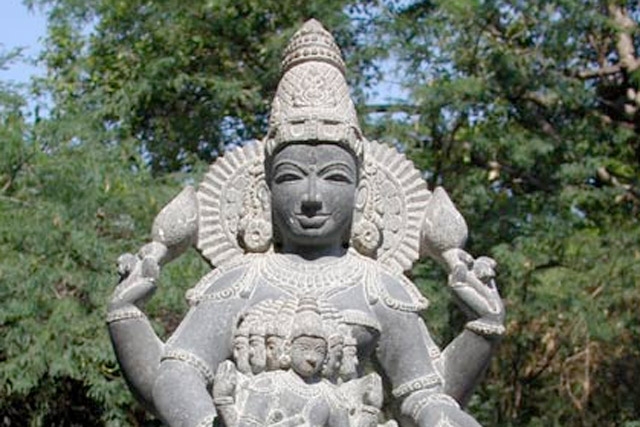
Shakti also refers to the manifestations of this energy, namely goddesses. Some goddesses embody the destructive aspects of shakti, such as death, degeneration, and illness, while other goddesses embody the creative and auspicious powers of shakti, such as nature, the elements, music, art, dance, and prosperity. Shakti may be personified as the gentle and benevolent Uma, consort of Shiva, or Kali, the terrifying force destroying evil, or Durga, the warrior who conquers forces that threaten the stability of the universe. Goddess worshippers often view their deity as the all-powerful Supreme Being, second not even to a male god. There are enduring goddess traditions all over India, especially in West Bengal and south India. Goddesses symbolizing various aspects of power very often predominate in village culture. Village men, women, and children, when they pray for immediate needs, address a female, not a male. David Kinsley writes:
Texts or contexts exalting the Mahadevi [Great Goddess], however, usually affirm sakti to be a power, or the power, underlying ultimate reality, or to be ultimate reality itself. Instead of being understood as one of two poles or as one dimension of a bipolar conception of the divine, sakti as it applies to the Mahadevi is often identified with the essence of reality (Ibid., 135).
The Hindu tradition also considers women the vessels of shakti. This identification with shakti acknowledges women as the vessels of both creative and destructive power. Like many modern cultures, Hindu culture has a hard time reconciling the biological compulsion of these two powerful forces. Some feminists and scholars criticize this identification because they believe it has led society to label women either as saints or sinners, with little room in between. They argue that women, like benevolent goddesses, are expected to exhibit forgiveness, compassion, and tolerance of others’ transgressions. If they conform to this role, patriarchal society accepts them; if they do not, and attempt to exhibit independence and assertiveness, they are considered destructive, disrupting community and family social structures. However, others argue that the idea of shakti can be used to empower Indian women to resist patriarchy. The debate continues.
Author: Jean Johnson.