
The Crisis In Burma: In Search of a Unified International Response
Co-organized with the Open Society Institute
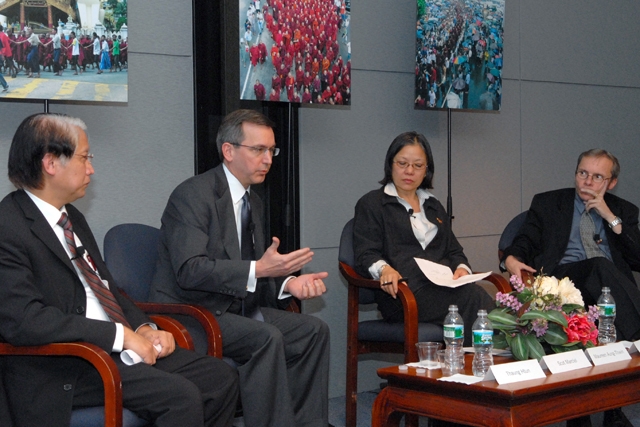
NEW YORK, March 25, 2008 - Six months after the Burmese military government’s violent crackdown on thousands of monks and other pro-democracy demonstrators, Asia Society and Open Society Institute convened a panel to revisit the situation in Burma in light of that government's recently announced "roadmap to democracy," which includes a planned national referendum on a new constitution in May, followed by a multiparty general election in 2010.
Stressing the need for the junta to engage in meaningful dialogue with opposition groups and leaders for the sake of Burma’s political future, Thaung Htun offered some possible options for how international actors and individuals can support meaningful progress towards national reconciliation. Scot Marciel described what US sanctions against Burma, coupled with diplomatic overtures to neighboring states and the UN, might mean for the future of democracy in Burma, while Sean Turnell assessed how the sorry state of Burmese economic institutions today sharply contrasts with its status as the richest country in Southeast Asia a century ago.
Maureen Aung-Thwin, Director of the Burma Project/Southeast Asia Initiative at the Open Society Institute, moderated the discussion.
Speakers:
Thaung Htun, Representative for UN Affairs, National Coalition Government of the Union of Burma
Scot Marciel, US Deputy Assistant Secretary of State for East Asian and Pacific Affairs
Sean Turnell, Co-Founder and Editorial Board Member, Burma Economic Watch; Professor of Economics, Macquarie University (Australia)
Maureen Aung-Thwin, Director, Burma Project/Southeast Asia Institute, Open Society Institute (moderator)
Suzanne DiMaggio, Director, Asian Social Issues Program, Asia Society (introduction)
Listen on Demand (1 hr., 34 min.)