
Breaking the US-Iran Stalemate
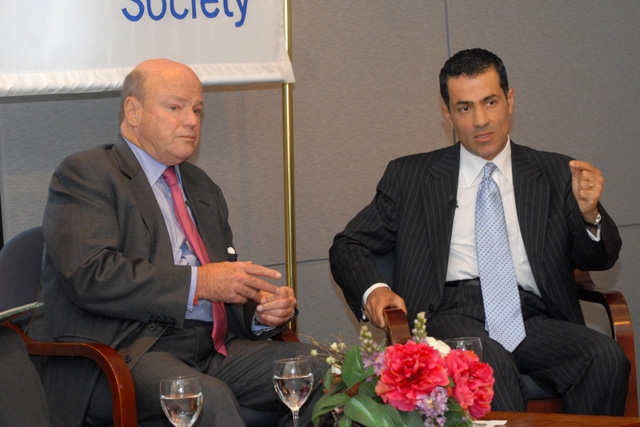
NEW YORK, October 14, 2008 — Resolving the diplomatic impasse between the United States and Iran will be among the most pressing foreign policy challenges the next American president will face, according to Ambassador Frank G. Wisner and Tufts University Professor Vali Nasr.
In a discussion moderated by the Asia Society's Suzanne DiMaggio, Wisner recommended the creation of a diplomatic framework modeled on the historic 1972 Shanghai Communiqué signed by China and the United States. He added that a careful exploration of issues should then be built on a foundation of mutual acceptance of each side's legitimacy and trust-building measures.
Wisner emphasized that the next administration's Iran policy must be both coherent and acceptable to multiple constituencies, including Israel and America's Arab allies. And it will also need to address the concerns of Congress and the American public, who have regarded Iran with suspicion since the 1979 hostage crisis.
From Iran's perspective, Nasr said, a new American president will not necessarily be a "game changer" and, as such, "radical" shifts on issues such as the nuclear program and Iraq shouldn't be expected. For starters, he argued, Tehran will require concrete examples of political goodwill. It will also need to convince its domestic audience that normalization is in Iran's interest, as well as promote a pro-US narrative that will overshadow memories of the 1953 CIA-led overthrow of Iran's democratically elected prime minister.
At present, both sides are balking. "Iran does not want to come to the negotiating table from a position of weakness. The US only wants to go from a position of strength," Nasr explained.
Nasr attributed the Bush administration's failures, in part, to an inability to realize that its allies' issues with Tehran don't necessarily mirror its own. Moreover, US policymakers have not fully acknowledged Iran's rising importance in the Middle East, the Caucasus, and South Asia.
Both experts agreed that direct engagement is a necessary step for addressing Iran's nuclear program. While a nuclear agreement would force Iran to give up any nuclear weapons ambitions, a regional security agreement would force the Islamic Republic to choose between its identity as a state and its ideology of resistance to Israel.
Reported by Michelle Nellett
Excerpt: Vali Nasr explains why the US approach to Iran has been so flawed (4 min., 10 sec.)
Excerpt: Nasr suggests new presidents in Tehran and Washington will not significantly affect either country's agenda (41 sec.)
Listen to the complete program (1 hr., 25 min.)