
The National Forum: Mapping Our Future in the Asian Century
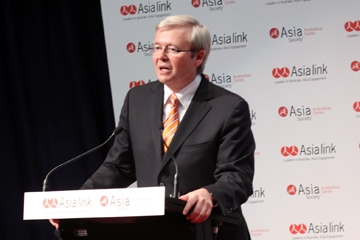
CANBERRA, May 25, 2010 - The Prime Minister, the Hon Kevin Rudd, and Opposition Leader, the Hon Tony Abbott, delivered major speeches, and the High Commissioner for India and the Ambassadors for China, Indonesia, Japan and the Republic of Korea participated in a panel discussion with Professor Tony Milner at the Asialink Asia Society National Forum at Canberra's Parliament House.
Entitled Mapping Our Future in the Asian Century, the Forum was unusual in covering so many aspects of Australia-Asia relations. It brought together 130 specialists and stakeholders from business, the arts, government, academia, public health, and development. This created an opportunity for cross-referencing between sectors, and building relationships that may be vital in furthering Australia’s effective engagement with the Asian region.
Forum discussion focused both on what the "Asian century" means in geo-strategic, economic, and cultural terms, and what it means for Australia in particular.
Participants started a stock-take, or health check, on how the country is progressing with regard to Asia engagement.
The annual PricewaterhouseCoopers Melbourne Institute Asialink Index, which covers progress in Australia's Asian engagement in the areas of trade, investment, education, tourism, migration, research and business development, and humanitarian assistance shows that engagement is four times what it was 20 years ago.
But the Forum raised some concerns, including:
- by international standards, Australia performs poorly in the way it projects itself in the region (soft power)
- very few Australians study in Asia
- investment, unlike trade, is an underdeveloped area of Australian economic engagement
- Australia’s involvement in the arts of the region is "sporadic and scattergun," which leaves the country largely excluded from the extraordinary cultural dynamism of contemporary Asia
- the study of Asian languages and Asian countries is faring very badly in Australia (even compared to a generation ago), despite government stress on the need for "Asia literacy"
- there is still a lack of broad Asia skills in Australian businesses, from boardroom to staff
This emphasis was present in the arts community and in the health area; in regional (including middle power) cooperation in defence; in the need for a deeper investment in relationships in business, in forging people-to-people links between young people, and in the development of a regional research community.
Has there been a shift in Australian thinking? Are Australians seeing their relationships in the Asian region less through the prism of the US alliance or the idea of Australia as primarily the communicator of global/Western values (and often aid), and increasingly as a more independent Australia engaged in reciprocal and creative collaborations in multiple fields?
The most serious anxiety at the meeting concerned the danger of the Australian community's not being prepared for the "Asian century." It is a concern about "Asia literacy," but not only within the education system. How well is the Australia prepared for living in a region where the United States influence might be substantially reduced, where new demands may be placed on its defence capacities, and where the English language might cease to be the main language of diplomacy and business?
Panelists voiced a concern that Australian leadership shouldn't move too far out in front of the Australian public in thinking about what future Asian engagement may entail. This led to a call for a national conversation to address this issue, a conversation that would need to consider not just the broad dimensions of what the "Asian century" might bring, but also help the community to think about such concrete issues as its often xenophobic responses to international investment.
One advantage of a national conversation that the participants noted would be to make sure that the different sectors in Australia-Asia engagement keep in touch with one another, and see possible connections in the problems they each encounter.
The Forum also identified the need for a second type of national conversation: one based on the strong need to build Australia's public diplomacy efforts in the Asian region. Opinion surveys in Asian countries and Australia underline the problems existing at the level of people-to-people links, and confirm the urgency of this proposal.
It was stressed that Australian relations in the region are becoming increasingly complex, which means Australia requires greater resources to advance Australian interests in the soft power area. This is not merely a matter of funding: at present the necessary skills base is lacking as well.
Here, as in so many areas of discussion, the Forum confronted the crisis of "Asia literacy." The fear, expressed repeatedly, is that the nation is really slipping backward at a time when the task of preparing for Australia’s Asian future is more urgent than ever before.
Reported by Professor Tony Milner and Jenny McGregor