
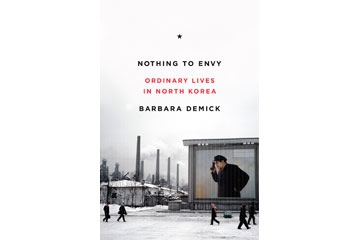
Nothing to Envy: Ordinary Lives in North Korea
Author describes how a nation of 23 million people stays literally in the dark
By Barbara Demick
Excerpted from Nothing to Envy (Spiegel & Grau, 2009) by Barbara Demick.
If you look at satellite photographs of the far east by night, you'll see a large splotch curiously lacking in light. This area of darkness is the Democratic People’s Republic of Korea.
Next to this mysterious black hole, South Korea, Japan, and now China fairly gleam with prosperity. Even from hundreds of miles above, the billboards, the headlights and streetlights, the neon of the fast- food chains appear as tiny white dots signifying people going about their business as 21st-century energy consumers. Then, in the middle of it all, an expanse of blackness nearly as large as England. It is baffling how a nation of 23 million people can appear as vacant as the oceans. North Korea is simply a blank.
North Korea faded to black in the early 1990s. With the collapse of the Soviet Union, which had propped up its old Communist ally with cheap fuel oil, North Korea’s creakily inefficient economy collapsed. Power stations rusted into ruin. The lights went out. Hungry people scaled utility poles to pilfer bits of copper wire to swap for food. When the sun drops low in the sky, the landscape fades to gray and the squat little houses are swallowed up by the night. Entire villages vanish into the dusk. Even in parts of the showcase capital of Pyongyang, you can stroll down the middle of a main street at night without being able to see the buildings on either side.
When outsiders stare into the void that is today’s North Korea, they think of remote villages of Africa or Southeast Asia where the civilizing hand of electricity has not yet reached. But North Korea is not an undeveloped country; it is a country that has fallen out of the developed world. You can see the evidence of what once was and what has been lost dangling overhead alongside any major North Korean road—the skeletal wires of the rusted electrical grid that once covered the entire country.
North Koreans beyond middle age remember well when they had more electricity (and for that matter food) than their pro-American cousins in South Korea, and that compounds the indignity of spending their nights sitting in the dark. Back in the 1990s, the United States offered to help North Korea with its energy needs if it gave up its nuclear weapons program. But the deal fell apart after the Bush administration accused the North Koreans of reneging on their promises. North Koreans complain bitterly about the darkness, which they still blame on the U.S. sanctions. They can't read at night. They can't watch television. "We have no culture without electricity," a burly North Korean security guard once told me accusingly.
But the dark has advantages of its own. Especially if you are a teenager dating somebody you can't be seen with.
When adults go to bed, sometimes as early as 7:00 pm in winter, it is easy enough to slip out of the house. The darkness confers measures of privacy and freedom as hard to come by in North Korea as electricity. Wrapped in a magic cloak of invisibility, you can do what you like without worrying about the prying eyes of parents, neighbors, or secret police.
Copyright © 2009 by Barbara Demick. Excerpted by permission of Spiegel & Grau, a division of Random House, Inc. All rights reserved. No part of this excerpt may be reproduced or reprinted without permission in writing from the publisher.
Purchase tickets to Asia Society's Barbara Demick event here.