
Can Pakistan Get Its Act Together?
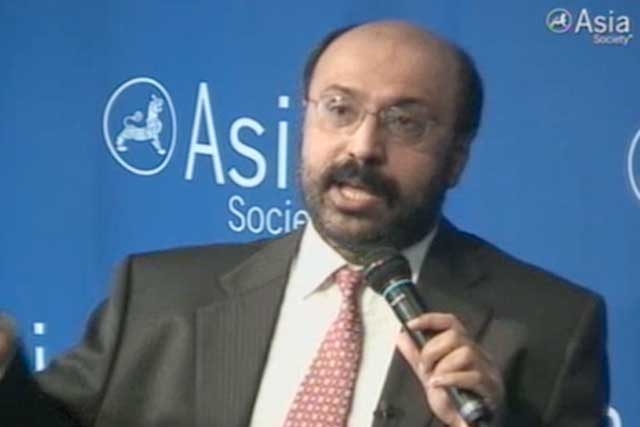
NEW YORK, April 13, 2010 - In a timely discussion examining the hurdles facing Pakistan's domestic and international state of affairs, Bernard Schwartz Fellow Hassan Abbas seemed buoyed by hope in the nation's ability to prevail, but emphasized that "it's a step-by-step process."
Though there are signals of a return to stable governance, the threats are still pervasive. Abbas noted that while significant progress had been made by the government in strategically targeting centers of the Taliban in Northern and Southern Waziristan and improved collaboration with the US, there remain pockets of militant groups concerned with Kashmir in Punjab which are not being tackled. This poses a serious problem for both India and Pakistan, both equally victims to the violence perpetrated by these groups, and requiring that both nations act together to face this threat.
As the discussion progressed, Asia Society Executive Vice President Jamie Metzl probed the evolving role of the military in the present and future governance of Pakistan. Abbas responded that the "Pakistan army is the most important political party in Pakistan. It's tragic, it's unfortunate, but that has been the case in the last 60 years." However he did stress that there has been ongoing friction between civil and military leadership. Abbas predicted that future army chiefs would likely have less power as democracy progresses.
Equally critical in rebuilding Pakistan, is the issue of identity. At its founding, the insufficient infrastructure allowed hardliners and mullahs to define the state in the name of Islam, obstructing the formation of a positive identity by more liberal leaders. The social and economic structure continues to be weak, thus spurring much of the social unrest the country faces.
Abbas explained, "Unfortunately some of the hawks in Pakistan thought that their strategic depth is in Afghanistan. The reality is that Pakistan's civilizational depth is in India." Thus, improving relations with India could be critical in mitigating security concerns as well as fomenting economic activity.
Abbas closed by recounting the dream of Pakistan's founders for a forward looking Muslim state. "If that dream can be realized," he said, "and I am confident...there are positive signs which can help Pakistan build up on that progressive dream."
This event was the launch of the Asia Society's Bernard Schwartz Fellows Program for 2010, and also the first in the Pakistan 2020: A Vision for Building a Better Future public program series.
Reported by Sandhya Kumar