Simulations: Real-World Practice
Simulations help students develop the knowledge, skills, and dispositions needed for success in the world at large. They provide a safe playing field for students to try new roles, skills, and responsibilities.
Simulations have proven to be an important tool to developing many aspects of global competence. They motivate students through real-world, relevant events. Simulations also compel students to combine content knowledge with critical thinking and reasoning skills.
Role-playing exercises may be part of the human condition. Experts believe that when children play, they often take on the role of someone older--often a parent or a professional. Child development specialists explain that this is simply a way for children to make sense of the world. Practicing different outcomes makes people, however young, understand variables and make them more comfortable in different situations.
Schools have used simulations for a long time. School newspapers and drama clubs, just to name two examples, mimic the practices of professional institutions as a way for students to learn how to strive for professional-level benchmarks.
It may sound like a cliche, but role-playing exercises that have an international or global dimension help students find commonalities and respect differences. Working with unfamiliar partners or on international conflict resolutions also helps students understand the local-global connection, as well as delve into roots of tradition and conflict.
Qualities of a Good Project
Here are some questions to ask when evaluating simulation projects and service providers:
- Is the project driven by relevant essential questions?
- Does it take into account perspectives from beyond the United States? How? (Tapping into international news sources, working with international partners)
- Does it use primary sources from around the world, as appropriate?
- Does it have real-world outcomes?
Get Started with Global Simulations
A great way to start is to use an existing program or service provider.
- GlobalEd 2 Project: Utilizing educational technologies currently available in most middle schools (computers with Internet connection), GlobalEd 2 situates students in a virtual, international decision-making environment focused on critical world issues. Across the country about 12-16 social studies classrooms participate in the simulation, each assigned a different country to represent. Within each classroom or country, students are further divided into a number of issue areas such as human rights, economic policies, environment, and health. The students in these issue area groups then interact with their counterparts in other countries over a five-week period, though a web-based environment in order to negotiate some mutually agreeable resolution to a world issue like water scarcity or global climate change.
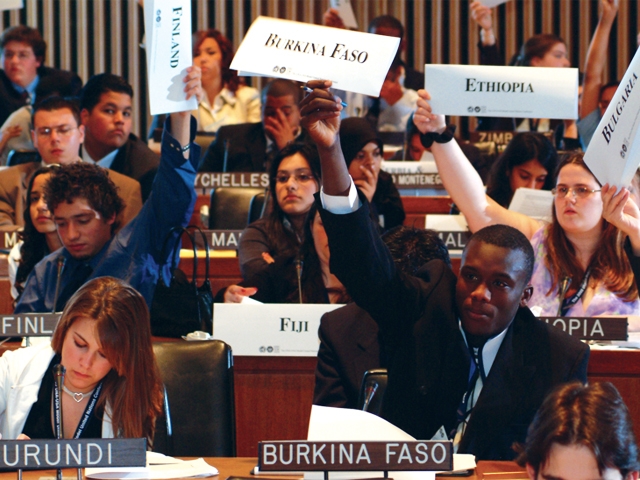
- Model United Nations, long popular in U.S. schools, allow students to assume the role of diplomats from a range of nations. As they research specific problems in their new roles, students see world issues from new perspectives and are forced to craft multi-nation resolutions as they learn first-hand about the structures and work of the United Nations.
- Capitol Forum, is a simulation sponsored by Choices for the 21st Century Education Program, a national education initiative based at Brown University that allows students to participate in U.S. foreign relations negotiations, centered around the question: What role should the United States play in the changing international environment of the 21st century?
- The World Affairs Challenge, from the Center for Teaching International Relations at the University of Denver, provides resources to school teams to study a different global theme each year. Teams then come together for a day-long event in which they present the results of their research, participate in a global quiz, and work on a "collaborative question" with students from other schools. Annual themes have included global health, the global marketplace, and conflict in the contemporary world.
- The ICONS Project, based at the University of Maryland, offers online role-play simulations on contentious global issues. Simulations are available on topics ranging from a Nigerian oil conflict to a crisis in North Korea. Some can run in just a few class periods, while others can involve multiple schools and last for a few weeks. All simulations take place within a password-protected online simulation platform, complete with instructional resources, a scenario, and a variety of communication tools.
- Federal Reserve Bank of New York provides a simulation exercise to help students understand how the Federal Open Market Committee (FOMC), made up of the seven members of the Board of Governors and the presidents of the 12 Federal Reserve Banks, makes monetary policy. Students must consider international conditions when making decisions.
Discussion
Have you used global simulations in your class? What advice do you have for other readers?