Women in Traditional China
by Patricia Ebrey
In China from very early times, men have been seen as the core of the family. The ancestors to whom a Shang or Zhou dynasty king made sacrifices were his patrilineal ancestors, that is, his ancestors linked exclusively through men (his father’s father, his father’s father’s father, and so on). When women enter the early historical record, it is often because they caused men problems. Some women schemed to advance their own sons when their husband had sons by several women. Women’s loyalties were often in question. In 697 BCE, for instance, the daughter of one of the most powerful ministers in the state of Zheng learned from her husband that the ruler had ordered him to kill her father. After her mother advised her that “All men are potential husbands, but you have only one father,” she told her father of the plot, and he promptly killed her husband. The ruler of Zheng placed the blame on the husband for foolishly confiding in his wife. Taken together, accounts of these sorts present a mixed picture of women and the problems they presented for men in the nobility. The women in their lives were capable of loyalty, courage, and devotion, but also of intrigue, manipulation, and selfishness.
Confucius probably took for granted these sorts of attitudes toward women, common in his society. He greatly esteemed ancestral rites and related family virtues such as filial piety. He hoped that through the practice of ritual everyone, male and female, high and low, old and young, would learn to fulfill the duties of their roles. Women’s roles were primarily kinship roles: daughter, sister, wife, daughter-in-law, mother, and mother-in-law. In all these roles, it was incumbent on women to accord with the wishes and needs of closely-related men: their fathers when young, their husbands when married, their sons when widowed. Confucius’s follower Mencius declared that the worst of unfilial acts was a failure to have descendants (Mencius 4A.26). In later centuries this emphasis on the necessity of sons led many to be disappointed at the birth of a daughter.
In the centuries after Confucius, it became common for writers to discuss gender in terms of yin and yang. Women were yin, men were yang. Yin was soft, yielding, receptive, passive, reflective, and tranquil, whereas yang was hard, active, assertive, and dominating. Day and night, winter and summer, birth and death, indeed all natural processes occur though processes of interaction of yin and yang. Conceptualizing the differences between men and women in terms of yin and yang stresses that these differences are part of the natural order of the universe, not part of the social institutions artificially created by human beings. In yin yang theory the two forces complement each other but not in strictly equal ways. The natural relationship between yin and yang is the reason that men lead and women follow. If yin unnaturally gains the upper hand, order at both the cosmic and social level are endangered.
Maintaining a physical separation between the worlds of men and the worlds of women was viewed as an important first step toward assuring that yin would not dominate yang. The Confucian classic the Book of Rites stressed the value of segregation even within the home; houses should be divided into an inner and an outer section, with the women staying in the inner part. One poem in the Book of Poetry concluded: “Women should not take part in public affairs; they should devote themselves to tending silkworms and weaving.” A similar sentiment was expressed in the Book of Documents in proverbial form: “When the hen announces the dawn, it signals the demise of the family.”
During Han times (202 BCE – 220 CE), both the administrative structure of the centralized state and the success of Confucianism helped shape the Chinese family system and women’s place in it. Han laws supported the authority of family heads over the other members of their families. The family head was generally the senior male, but if a man died before his sons were grown, his widow would serve as family head until they were of age. The law codes of the imperial period enforced monogamy and provided a variety of punishments for bigamy and for promoting a concubine to the status of wife. Men could divorce their wives on any of seven grounds, which included barrenness, jealousy, and talkativeness, but could do so only if there was a family for her to return to. There were no grounds on which a woman could divorce her husband, but divorce by mutual agreement was possible.
Much was written in Han times on the virtues women should cultivate. The Biographies of Exemplary Women told the stories of women from China’s past who had given their husbands good advice, sacrificed themselves when forced to choose between their fathers and husbands, or performed other heroic deeds. It also contained cautionary tales about scheming, jealous, and manipulative women who brought destruction to all around them. Another very influential book was written by Ban Zhao, a well-educated woman from a prominent family. Her Admonitions for Women urged girls to master the seven virtues appropriate to women: humility, resignation, subservience, self-abasement, obedience, cleanliness, and industry.
By the end of the Han period, the Confucian vocabulary for talking about women, their natures, their weaknesses, and their proper roles and virtues was largely established. The durability of these ways of thinking undoubtedly owes much to continuities in the family system, which from Han times on was patrilineal, patrilocal, and patriarchical, and allowed concubinage. At marriage a woman had to move from the household of her father to that of her husband’s parents. Given the importance assigned to continuing the ancestral sacrifices through patrilineal descendants, a wife’s standing within her family of marriage depended on the birth of male heirs. Yet, because of the practice of concubinage, even if a wife bore sons, her standing could be undermined if her husband took concubines who also bore sons. Thus, so long as the family system continued without major change, women would continue to resort to strategies that seemed petty or threatening to men, and not until a woman became a grandmother was she likely to see the interests of the family in the same way men in the family did. To most of those who left written record, however, the problem did not lie in the family system, but in moral lapses. Thus, moralists held up models of self-sacrificing women for emulation, women who adhered to principles of loyalty, chastity, and faithfulness, often at great personal cost.
By Song (960-1279) times, historical sources are diverse enough to see that women undertook a wide range of activities never prescribed in Confucian didactic texts. There were widows who ran inns, midwives delivering babies, pious women who spent their days chanting sutras, nuns who called on such women to explain Buddhist doctrine, girls who learned to read with their brothers, farmers’ daughters who made money by weaving mats, childless widows who accused their nephews of seizing their property, wives who were jealous of the concubines their husbands brought home, and women who drew from their dowries to help their husband’s sisters marry well.
It is often said that the status of women began to decline in the Song period, just when Neo-Confucianism was gaining sway. The two signs of this decline most frequently mentioned are the pressure on widows not to remarry and the practice of binding young girls’ feet to prevent them from growing more than a few inches long. Foot binding seems to have steadily spread during Song times, and explanations for it should be sought in Song circumstances, but widow chastity had very little specific connection to the Song, the idea predating the Song and the exaggerated emphasis on it developing much later.
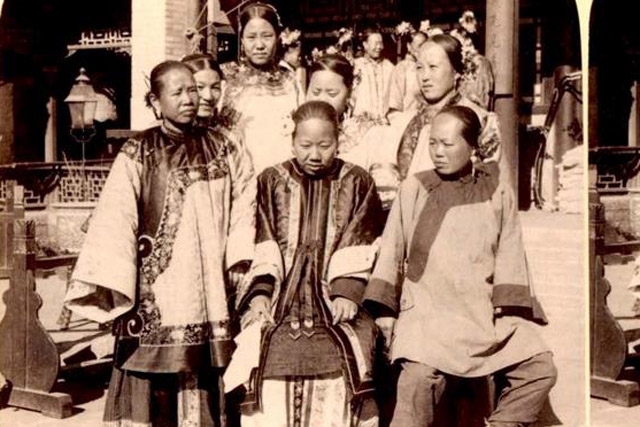
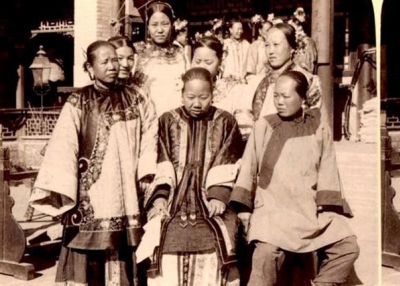
Foot binding was never recommended by Confucian teachers; rather, it was associated with the pleasure quarters and with women’s efforts to beautify themselves. Mothers bound the feet of girls aged five to eight, using long strips of cloth. The goal was to keep their feet from growing and to bend the four smaller toes under to make the foot narrow and arched. Foot binding spread gradually during Song times but probably remained largely an elite practice. In later centuries, it became extremely common in north and central China, eventually spreading to all classes. Women with bound feet were less mobile than women with natural feet, but only those who could afford servants bound their feet so tight that walking was difficult.
By contrast, the idea of widow chastity was not new in Song times. Ban Zhao had written, “According to ritual, husbands have a duty to marry again, but there is no text that authorizes a woman to remarry.” The increased emphasis on widow chastity has usually been blamed on the Neo-Confucian philosopher Cheng Yi, who once told a follower that it would be better for a widow to die of starvation than to lose her virtue by remarrying. In later centuries, this saying was often quoted to justify pressuring widows, even very young ones, to stay with their husband’s family and not marry someone else. One reason widows in Yuan (Mongol) (1215-1368) and Ming (1368-1644) times might have wanted to remain with their husbands’ families is that they no longer could take their dowries into a new marriage. When the husband’s family did not want to provide support for a son’s widow, the moral stricture against remarriage would have helped the widow insist that she be allowed to stay and adopt a son.
By the early Qing period (1644-1911), the cult of widow chastity had gained a remarkably strong hold, especially in the educated class. Childless widows might even commit suicide. Young women whose weddings had not yet taken place sometimes refused to enter into another engagement after their fiancé died. Instead, they would move to their fiancé’s home and serve his parents as a daughter-in-law. Although most Confucian scholars and government officials disapproved of widow suicide and chaste fiancées, they often expressed great admiration for the determination of particular women they knew, thus helping spread the custom.
At the same time that widow chastity was becoming more prevalent, more and more women were learning to read and write. In the seventeenth and eighteenth centuries a surprising number had their poetry published. Women with poetic talents figure prominently in the great eighteenth-century novel, The Dream of Red Mansions (also called Story of the Stone). Although the male hero, Baoyu, is a young man of great sensitivity, several of his female cousins are even more talented as poets. Some women in this large fictional family have considerable power—especially the grandmother who can force her sons and nephews to do what she wants, and the daughter-in-law who handles the family’s finances. The young unmarried women, however, may have been able to acquire literary educations as good as the boys, but they had even less control over their fates than he had.
As in much of the rest of the world, in twentieth century China, intellectuals and social activists leveled many criticisms against the old family system and especially the ways it limited women’s chances. Foot binding, widow chastity, parental control of marriage, and concubinage have all been eliminated. It should always be kept in mind, however, that a great many women were able to fashion satisfying lives under the old system.


Are You Looking for PD?
Are you an educator or education professional looking for professional development resources? Read about our online courses!
Connect With Us
Asia Society
725 Park Avenue
New York, NY 10021
t: 212-327-9260
[email protected]
Follow Our Blog on Education Week