Women in Modern Mongolia
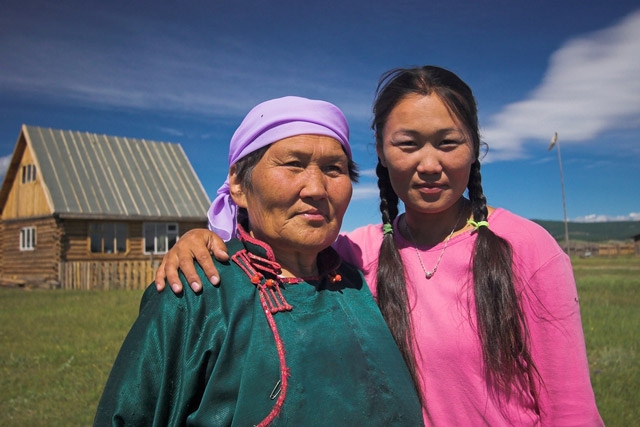
Mongol women enjoyed, or some would say endured, a vital role in the often times harsh nomadic life. In recent decades, women saw greater equality in education and the workplace. As Mongolia continues to shape its identity in the modern world, this essay examines some of the issues and opportunities facing women today.
Because women in pre-twentieth-century Mongolia assumed such vital roles in the livestock economy, a few among the elite enjoyed more rights and privileges than their counterparts in other East Asian lands. The capriciousness of the Mongol environment and the demanding lifestyle of the steppe pastoral nomads necessitated hard work and assumption of responsibilities by all household members, and women often had the heavier loads. They not only had domestic duties but also assisted in tending animals, milking sheep and goats, producing dairy products, shearing wool, and tanning hides. They could manage the herds on their own, permitting total male mobilization for hunts or warfare. Their vital economic roles translated into considerable power for a few elite women. It is no wonder that some achieved prominence beyond Mongolia. For example, the Persian historian Rashid al-Din wrote that Khubilai Khan’s mother Sorghaghtani Beki was “extremely intelligent and able and towered above all the women in the world.” She, together with Khubilai’s wife Chabi, exerted considerable influence on the policies the Mongols pursued.
Yet ordinary Mongol women probably did not benefit from their vital roles, particularly after the Mongol empire collapsed. They returned to a life of drudgery, with limited, if any, possibilities, for leisure and education and almost no access to proper health care. Qing China’s conquest of Mongolia in the late seventeenth century exacerbated women’s difficulties and indeed generally pauperized the Mongol peoples.
Socialist Mongolia and Women
Even the fall of the Qing in 1911 did not lead to improvement, as chaotic conditions prevailed until 1921. In that year, Mongol nationalists, with the help of the Soviet Union, gained power and began to set up a socialist regime, which lasted for about seventy years. Attempted collectivization of the herds, dictatorial rule, purges of Buddhist monks and others considered to be dissidents, severe limitations on all forms of literary, artistic, and political expressions, and deprivation due to some economic mismanagement followed. To be sure, the period of socialist governance also witnessed gains, particularly in education, health, and social welfare.
Women often benefited from government policies, which in theory guaranteed equality in education, the workplace, and the political system. By the late 1980s, most women had entered the labor force in such sectors as trade, medicine, and education, but a “glass ceiling” frequently prevented promotion to leadership at work or in the professions. Government initiatives in modernization of health care provided medical services for women, who in fact constituted about three-quarters of the doctors by 1990. A pronatal policy from the 1960s on led to improvement in facilities for pregnant women and thus lowered infant mortality (though the government at the same time banned abortions). Maternity leave was generous, and crèches and nursery schools facilitated women’s working lives. Welfare benefits, such as pensions for the elderly and subsistence payments for widows and the disabled, also assisted women because they were often responsible for these groups. Moreover, in the rural areas, women herders were eligible for pensions, a unique policy in Asia.
Opportunities for women’s education and for participation in politics increased. The government initiated compulsory education for girls in both urban and rural areas, resulting in a dramatic growth in literacy and in access to higher education. Although the government’s figures on literacy may have been overstated, still even the lower estimates devised by independent specialists were impressive. Herder parents strove to ensure education for their daughters so that they could avoid the hard life endured by women in a nomadic pastoral society. Success of these government policies can be gauged by the fact that, by 1990, more than forty per cent of university and technical college graduates were women. In the government itself, women registered gains. They constituted about one-quarter of the Parliament (or Khural), but none reached the most important levers of government, including Prime Minister or Foreign or Defense Minister.
Women in Post-Socialist Mongolia
The 1991 collapse of the Soviet Union and government policies since then have generated opportunities and problems for women. The Soviet Union and the Eastern European bloc had been Mongolia’s virtually sole trading partners, investors, and suppliers of foreign aid. Sudden diminution of these relationships necessitated a realignment of Mongolia’s economy. The government turned to such international financial organizations as the Asian Development Bank, the World Bank, and the International Monetary Fund and such aid organizations as the Japan International Cooperation Agency and the U.S. Agency for International Development, for advice and assistance. The foreign institutions recommended changes from a planned to a market economy, which entailed privatization of State assets, elimination of government subsidies, a balanced budget, reductions in government, and austerity.
These dramatic changes have affected women. On the one hand, the socialist regime’s repression has ended, leading to less fear of government purges and to greater freedom and more choice for women. A multi-party political system and more outlets for dissent have expanded their political choices. On the other hand, economic failures have fallen disproportionately on women. Rates of female unemployment and poverty have soared, and despite economic growth since 2002, the percentage of those living in abject poverty (as of this writing in late 2007) remains above thirty per cent. More women than men are unemployed, as private companies, claiming that young women either take extended leaves or simply drop out of the labor force when they become pregnant, have often been reluctant to hire females. If they do, they frequently do not offer the fringe benefits that the socialist State had previously provided. In addition, the latest United Nations Development Program report notes that “there is a wage gap in Mongolia. Women are under-represented in sectors with higher pay.” Moreover, many working women spend as much as twenty-five hours a week on household chores, as they “carry a double burden with responsibilities at work and at home.” Adding to these difficulties is the substantial increase in female-headed households, which is, in large part, due to male unemployment and the resulting high rate of alcoholism, crime, and domestic abuse. Faced with these difficulties, an increasing number of women have divorced unstable husbands or have opted to have children without marriage. However, female-headed households have been vulnerable and constitute a large segment of those living below the poverty line.
Government cutbacks have also hurt women. The socialist State’s support for pastoral nomads (construction of wells, supplying of trucks to bring animals and animal products to market, provision of veterinarians, etc.) have eroded, causing many families to abandon herding and to migrate to the capital where most, with scant economic prospects, live in abject poverty. The social safety net (special care for pregnant women, subsidies for food, energy, and housing, stable pensions, provision of crèches, etc.) has withered away. Health facilities have deteriorated, with State reductions in funding to hospitals for medicines, equipment, and supplies, in support for feldshers in the countryside, and in proper pay for public service doctors and nurses. These social problems have inevitably led to a rise in prostitution, trafficking of women, and street children of both sexes.
One encouraging trend is the recognition of the serious problems facing Mongol women. Educated women have banded together to form non-governmental organizations to criminalize domestic abuse, to improve conditions for women in the labor force, to conduct research on employment, prostitution, child labor, and inequalities in wages for women. One such organization concluded that “there is a clear need for government policies and schemes to improve the position of women in the labor force…” Foreign agencies, such as the United Nations Development Program and the World Bank, have experimented with provision of micro-credit for women seeking to increase their incomes and have issued reports on gender gaps in employment and sexual harassment in the workplace.
An important change in the government has been the first appointment of women to significant positions in the Cabinet. Since 1999, two women have filled the post of Minister of Foreign Affairs. Finally, education favors women in future. More than seventy per cent of students in higher education are women, offering hope for their rise to managerial positions in the economy, health, education, and government and to attempts to address the problems faced by Mongol women.
Footnotes
1 John A. Boyle, trans., The Successors of Genghis Khan (New York: Columbia University Press, 1971), p. 168.
2 United Nations Development Program, Mongolia Human Development Report 2007: Employment and Poverty in Mongolia: Executive Summary (Ulaanbaatar, 2007), pp. 26, 28.
3 Liberal Women’s Brain Pool, Women’s Empowerment and Development (Ulaanbaatar, 1998), p. 49. On one of the women’s non-governmental organizations and its activities, see Mones: Mongolian Women’s Fund, Annual Report 2006 (Ulaanbaatar, 2007).
4 For additional detail and bibliography, see Morris Rossabi, Modern Mongolia: From Khans to Commissars to Capitalists (Berkeley: University of California Press), pp. 150-160.
Author: Morris Rossabi.