
Mongol Illustrated Manuscripts
The Jami al 'Tawarikh and the Shahnama
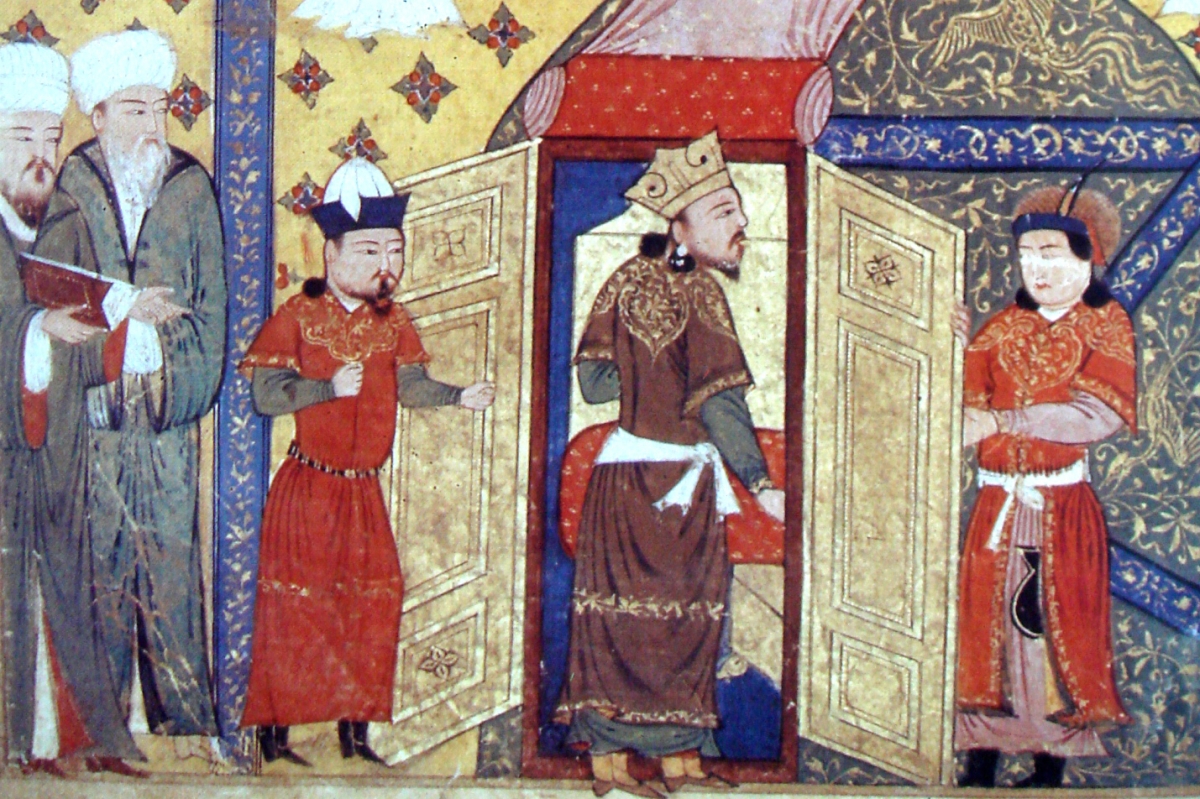
The arts of greater Iran (comprised of what is now Iran, Afghanistan, and parts of Iraq, the Caucasus and Central Asia) used to be very decorative before the Mongol invasion of much of Eurasia (13th century). After Mongol rule in the area, arts patronage largely focused on illustrated epics. This is a brief backgrounder with a link to an illustrated classic.
The Mongol invasion of greater Iran in the thirteenth century brought many changes to the arts traditions there. Before Mongol rule, Greater Iran was ruled by various Turkic dynasts for almost two centuries. These Turkish rulers adopted local practices and ruling customs in order to curry favor with their Iranian subjects, and took on the role of art patron with particular gusto. Under Turkish art patronage, the Persian decorative arts flourished. Ceramic craftsmen abounded, and luxury textiles and vessels became increasingly lavish and refined.
The arrival of the Mongols brought a shift away from patronage of the decorative arts to that of calligraphy and the illustrated manuscript. The lion's share of Ilkhanid (Persian Mongol) art patronage went to the creation of illuminated historical works and epic poems. These commissioned historical works glorified the dynasty's achievements and ideological preferences. The most famous of these historical works is the Jami 'al-tavarikh (Compendium of Chronicles.)
The Compendium was a groundbreaking work in its ambitious scope and multicultural sensibility. Commissioned by Ilkhanid rulers Ghazan and Oljeitu in the fourteenth century, the Compendium can be seen as an encomium to both Mongol history and Mongol commitment to Iran's local pre-Mongol cultural heritage. Rashid al-Din--the Ilkhanid vizier who set the creation of the Compendium into motion and wrote at least part of it--was influenced by the Ilkhanid capital of Tabriz itself, a bustling and modern urban hub where European and East Asian culture and politics converged. The Compendium consists of four volumes covering an astonishing breadth of information including, a history of Ghazan Khan (volume 1), a universal history (volume 2) probably some four hundred folios in length, a survey of the genealogies of the Arabs, Jews, Mongols, Franks and Chinese (volume 3), and a geographical compendium (volume 4).
The text of the Compendium is accompanied by roughly 540 paintings depicting landscapes, people, historical battle scenes and enthronements, and scenes from the Old Testament and the life of Prophet Muhammad. The religious paintings occur most frequently, and with fresher vision and greater originality, than the other types of paintings in the Compendium.
The Shahnama, or Book of Kings, was the most prominent illustrated text of the Mongol period. Firdausi's epic sixty thousand couplet-long poem draws on Iran's history and mythology for its astonishingly vivid repertoire of figures and fables. The Shahnama delves into the histories of Iran's cultural heroes, villains, leaders and kings--both fictional and historical--over a breathtaking span of several centuries. Calligraphers and artists lavished Firdausi's text with embellishment and accompanying images. The masterpiece of Ilkhanid painting is considered to be the fourteenth century Great Mongol Shahnama, which was the largest and most technically sophisticated manuscript of the Ilkhanid school at large. Within this one text, "one can trace the sequence from paintings that are simple illustrations to ones that are commentaries, then metaphors, and finally independent works of art operating confidently on several levels of meaning. More and more content--descriptive, emotional, historical, symbolic--is gradually pumped into these paintings, and only an absolutely assured command of pictorial language enables the greatest of these painters to control the forces that they unleash." [2]
The Shahnama continued to be illustrated for centuries after the Mongol conquest. Shah Ismail first encountered local Turkmen illustrations from the Shahnama as a young boy, while staying at the court of Karkiya Mirza Ali in Gilan from 1494-1499. The tales of epic battle, warrior-heroes, enchanted princesses and kings would have doubtlessly impressed and captivated the young boy's mind. It is not surprising, then, that Ismail commissioned the creation of a royal Shahnama to commemorate the birth of his own son, Prince Tahmasp, around 1515. Furthermore, as the first self-appointed Shah of the Safavid dynasty (which he had himself expanded to include most of Iran), Ismail adopted Persian models of government and bureaucracy. Ismail must have hoped that giving importance to the Shahnama would legitimize his claim of inheriting the Persian monarchy.
The royal Shahnama commissioned by Ismail yielded four paintings, the most famous being "Sleeping Rustam" (on view at Asia Society.) For unknown reasons, this manuscript project was then abandoned. Prince Tahmasp would commission his own royal Shahnama, which would become the masterpiece of its day. A collaborative effort, "some fifteen painters, at least two calligraphers, two or more illuminators, gold sprinklers, binders, margin makers, paper burnishers and a team of assistants would have combined their skills to produce the most lavish manuscript seen in Iran for a century." [3]
Tahmasp's royal Shahnama is the culmination of the talents of several master artists. Sultan Muhammad, probably the first director of the Shahnama project, used a rich palette of color and emotion in his paintings. His early illustrations of Shahnama scenes are hectic: color-saturated architecture and textiles coexist with people, angels, whirlwinds, earth spirits, animals and clouds, all frozen in a moment of dramatic activity. Mir Musavvir, the second director, had a much different approach to illustration. Linear, analytic and almost mathematical in its precision, Musavvir conjured a meticulous and composed world. Aqa Mirak, a later contributor, would achieve balance in his complex compositions by eschewing symmetry and finding balance instead through the interrelationships of the vivid, sharp lines of his figures, architecture and landscape elements. These different styles do not produce dissonance but aptly animate the Shahnama text, itself a vivid and varied tale of many tales.
Perhaps the most interesting feature of Tahmasp's royal Shahnama is that its artists depicted the characters and events in contemporary Safavid garb and settings. As such, these paintings can be studied by anyone interested in gaining an intimate window into Safavid court life and architecture, portrayed as the Safavids themselves would have preferred.
Notes
1 Welch, Anthony. Calligraphy in the Arts of the Muslim World. University of Texas Press, 1979.
2 Kamarovv, L. and Carboni, S. The Legacy of Genghis Khan: Courtly Art and Culture in Western Asia, 1256-1353. Yale University Press, New Haven and London 2002. p 146.
3 Thompson, J. and Canby, Sheila R. Hunt for Paradise: Court Arts of Safavid Iran 1501-1576. Skira Editore S.P.A., Italy 2003, p. 84.
Author: Zainah Mahmood.