Islamic Belief Made Visual
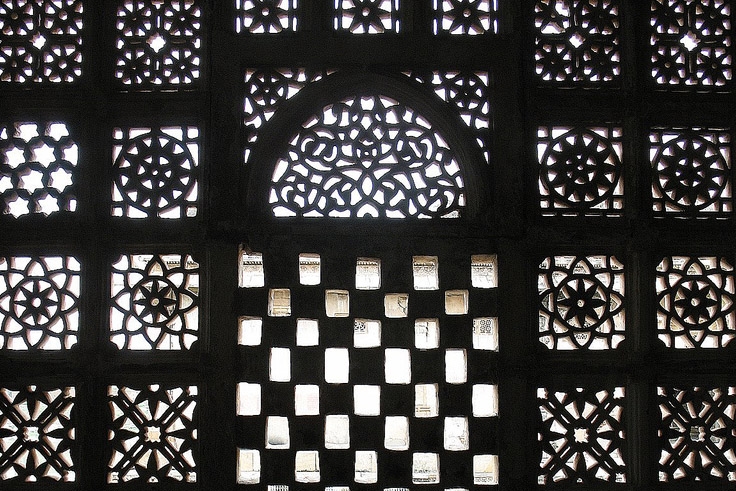
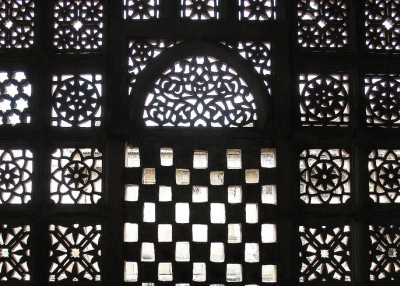
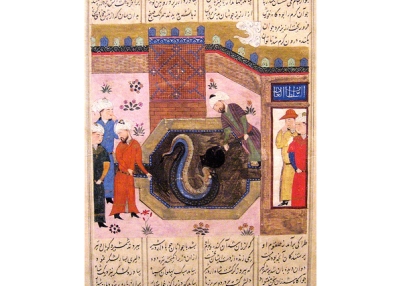
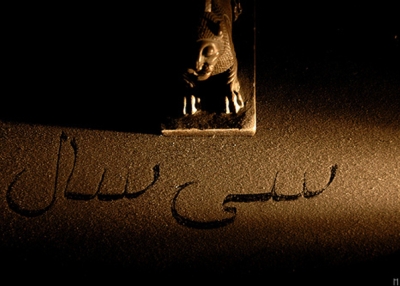
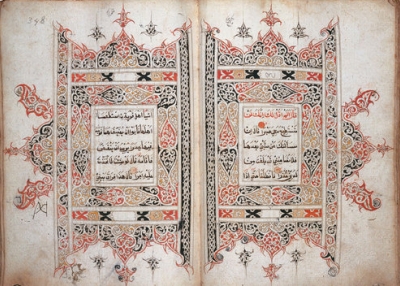
The visual arts allows us to understand people of earlier eras: visual literacy reveals many things about what these people did, knew, and believed. Examining the geometric patterns that characterize so much of Islamic art can provide students with important insights into the technology, scientific knowledge, and religious beliefs of Muslims. Appreciation for a basic relationship between the art and the religion of Islam increases with familiarity. Careful observation of the illustrations here will provide an introduction to Islamic religious beliefs through its art.
Geometric motifs were popular with Muslim artists and designers in all parts of the world, at all times, and for decorating every surface, whether walls or floors, pots or lamps, book covers or textiles. As Islam spread from nation to nation and region to region, artists combined their penchant for geometry with pre-existing traditions, creating a new and distinctive Islamic art. This art expressed the logic and order inherent in the Islamic vision of the universe.
Although the shapes and structures are based on the geometry of Euclid and other Greek mathematicians, Islamic artists used them to create visual statements about religious ideas. One explanation of this practice was that Mohammad had warned against the worship of idols; this prohibition was understood as a commandment against representation of human or animal forms. Geometric forms were an acceptable substitute for the proscribed forms.
An even more important reason is that geometric systems and Islamic religious values, though expressed in different forms, say similar things about universal values. In Islamic art, infinitely repeating patterns represent the unchanging laws of God. Muslims are expected to observe strict rules of behavior exactly as they were orginally set forth by Mohammad in the seventh century. These rules are known as the "Pillars of Faith":
- pronouncing the creed (chanting an affirmation of the existence of one God and that God is Allah)
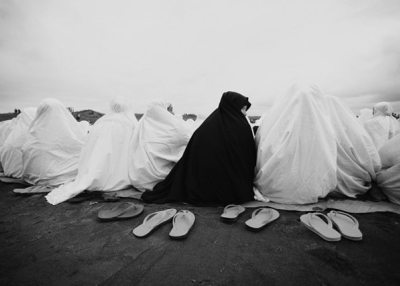
- praying, in a precisely defined ritual of words and motions, five times a day
- giving alms
- fasting during the month of Ramadan (time varies according to lunar calendar)
- making, during a lifetime, at least one pilgramage to Mecca
The strict rules for construction of geometric patterns provide a visual analogy to religious rules of behavior. The geometric patterns used in Islamic art are aggressively two-dimensional. Artists did not want to represent the three-dimensional physical world. They preferred to create an art that represents an ideal, spiritual truth. Ideals are better represented as two-dimensional than three-dimensional.
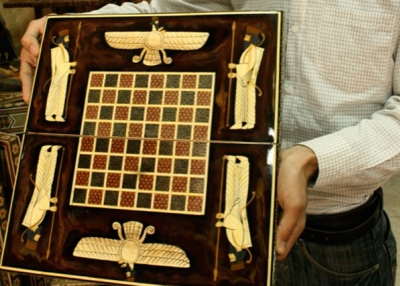
The star was the chosen motif for many Islamic decorations. In Islamic iconography the star is a regular geometric shape that symbolizes equal radiation in all directions from a central point. All regular stars—whether they have 6, 8, 10, 12, or 16 points—are created by a division of a circle into equal parts. The center of the star is center of the circle from which it came, and its points touch the circumference of the circle. The center of a circle is an apt symbol of a religon that emphasizes one God, and symbol of the role of Mecca, the center of Islam, toward which all Muslims face in prayer. The rays of a star reach out in all directions, making the star a fitting symbol for the spread of Islam.
Many of the patterns used in Islamic art look similar, even though they decorate different objects. Artists did not seek to express themselves, but rather, to create beautiful objects for everyone to enjoy. It takes considerable experience in analyzing Islamic patterns before discovering that seldom are two designs exactly alike. That is worrisome to Westerners because of the premium placed in the West on originality in evaluating an artist. Not so in Islam; there the artist sees himself as a humble servant of the community, using his skills and imagination to express awe of Allah, the one God, eternal and all-powerful.
Related Student Activity: Geometry and Islam
A short student activity that introduces why patterns are used in Islamic books, textiles and architecture and how to use a compass and a ruler to create two common patterns.
Students will:
- Understand the significance of geometric patterns in the Muslim world
- Replicate common patterns that adorn architecture, texts and textiles
- Practice using a compass and straight edge
Process:
- Read and summarize the above "Islamic Belief Made Visual" essay for students.
- Give each student a piece of paper or poster board, compass, straight edge and copies of the handout, "Construction of an Islamic Pattern."
- Through demonstration and/or one-on-one work, help students replicate common geometric designs seen throughout the Muslim world.
For elementary school students: color the patterns to bring out geometric shapes. You may want to paper a bulletin board or wall with student artwork.
Copyright 1998.
Author: Jane Norman.