The Desi Diaspora
Indian Migration and Nationalism in the 19th and 20th Centuries
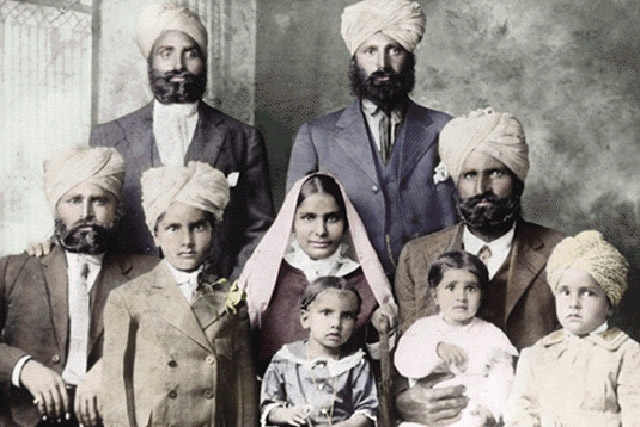
Diaspora is migration during the era of nationalism, not just a scattering of peoples but also a politico-emotional gathering in far-off lands under the sign of the nation. Diaspora is an idea that only makes sense in the era of nationalism. Prior to nationalism’s birth in the 19th century, people moved routinely. They traveled from their local places of birth and social sustenance to territories so far that they lost touch with their early homes. Most of these migrants did not think of themselves as part of a coherent diaspora, mainly because they did not see their places of origin as part of a national project. When people of the Indian subcontinent (desis, or those from the desh, homeland), for instance, commonly traveled to Southeast Asia or to Africa as part of the world of the Indian Ocean (that has been called the Afrasian Sea), there is no evidence that they saw themselves as part of a desi diaspora. [note 1] On the contrary, they took with them social practices, habits and materials from their homelands, moved to far-off locales and set to work in the construction of a new ethos, one that was defined in conversation with the materials and ideas that they found in those parts.
The ancient and early modern migrations of people from the Indian subcontinent are a prelude to the diaspora of the 19th century and after, but they are not a part of it. What defines the diaspora of the 19th century onwards, in the era of nationalism, is that as people left a homeland that was already seen as a “nation,” they continued to bear fond memories of that homeland and saw themselves as somewhat patriotic to it. Even though the word diaspora comes to us from the Greek for scattering (which implies any migration) and even though it is classically used to refer to the Jewish Diaspora after the destruction of the Temple in 70 C.E. [note 2], the concept in modern times refers specifically to the idea of a departure from a national homeland and a nostalgia for that homeland. Thus the two kinds of migration should not be conflated.
Plantation Indenture
With the end of plantation slavery in the 1830s, British imperial authorities searched for labor to replace the slaves on their sugar plantations. “Free” labor was not to replace slave labor, because the planters refused to hire Africans in the Caribbean on negotiable terms and the Africans refused to be hired to work in slave conditions. The imperial plantocracy fell upon the idea of indentured labor first in Mauritius, then elsewhere: hire labor for a term of five years (with the option of an additional five) and then send the worn-out workers back to the care of their families. Recruiters (arkatis) working in the Gangetic Plain and on the Coromandel Coast between 1834 and 1916 sent about five million Indians to distant lands. British colonial capitalists used these indentured workers to produce stimulants (cocoa, tea, coffee, sugar) for the newly industrialized English work force back home.
Alongside the indentured laborers, merchants and dukawallas (Swahili for “shopkeepers”) traveled to southern and eastern Africa, using their extensive contacts and experience in the Indian Ocean trade to insert themselves into the colonial economy. Areas of trade abandoned by the colonial state and by imperial capital—such as tending shops in the interior, trading in lesser commodities, and processing cotton for export—became the preserve of the Indian merchant. It was these merchants who hired M. K. Gandhi in 1894, and this period of time in South Africa that earned him a place in the history of the desi diaspora.
Whereas from the inception of indenture the planters and the colonial state saw a community of laborers, overseas Indians did not immediately see themselves as a distinct community. The first non-Europeans to consider the indentured laborers as a community were the Indian missionaries (Hindu, Muslim, and Sikh). At the beginning of the twentieth century, Hindu reformers noticed the overseas population and felt inclined to go and “reclaim” them for the “motherland.” The missionaries attempted to teach the dispersed peoples a language (standardized Hindi), customs, and a religion their various and competing brands of Hinduism). Clerics of Islam also traveled to the far-flung colonies, and they too attempted to “reclaim the lost brethren” for the homeland’s Islam. Against the aggressive and state-sponsored Christian missionaries and the richly textured unorthodox popular cultures of indenture, the Hindu and Muslim orthodoxy fought to repatriate them into their native religions.
Although there were differences among the Indian organizations, they operated similarly. Each attempted to gather overseas Indians and connect them with their distant homeland through the reintroduction of language, religion, and culture, which the overseas (ex-) indentured laborers sought for their children and themselves. The gathering succeeded in reestablishing “India” in the central consciousness, but the orthodox leadership referred to culture as the old customs of spirituality and domesticity, not the actual life experiences of the people.
The actual lives of the desis included the brutality of indenture, the monotony of work life on a plantation, the attempt to find solace in religious and spiritual traditions, the divisions between the Africans and the Asians, the difficulty of forming family and other social networks in the midst of the plantation, and the attempt to make the landscape both familiar and sacred. These conditions were basic to the everyday life of the people, but the orthodox leadership ignored them.
The colonial state gave the orthodox priests the authority to speak for “Indian culture,” and these priests made the most of it by reducing the richness of the people’s traditions—solidarity, struggle, peasant customs, folk values—to spiritualism and religion. The daily struggles gave rise to an ideology, igniting a series of events in the diaspora in 1913-14. The various movements led by indentured laborers in different colonies during that period offer us some indication of the laborers’ self-consciousness of their common condition. Bharath, one indentured laborer, sang of the plantocracy taking labor from the ships, the jahaj: “take out four hundred, five hundred, some pick out de Jamaica, some pick out de b.g. [Guyana]/natal ooutari [takes], jamaica ooutari, guyana ooutari.” [note 3] The events of 1913-14 made it clear that Indian laborers around the world, from Fiji to British Guyana to Canada, shared a common predicament: their labor was needed, but not their lives. Come and work, but do not come and live here: that was the message given to the laborers, who struggled to make sense of their existence in racially charged areas, given the British efforts to divide the local populations (in Fiji, between desis and Fijians; in the Caribbean, between desis and Africans brought in).
Four events of 1913-14 signaled the gathering of desi awareness as outcasts in the international community: Kunti’s Fiji letter, the foundation and activities of the Ghadar Party, the strikes in Natal, and finally, in 1914, the trials of the Komagata Maru.
Kunti’s Cry—May 1913
The plight of Indians in Fiji was dramatically brought home when Kunti’s story appeared in the newspaper Bharat Mitra on May 8, 1913. In her widely circulated letter, Kunti claimed to have been sent to work in an isolated part of the field by her overseer. The overseer followed her and tried to rape her, but she freed herself, jumped into a nearby river, and was luckily saved by a young desi. When she tried to report the incident to the white plantation owner he said, “Go away, I don’t want to hear about field things.” [note 4] “Field things” were a common occurrence in most plantations, and Kunti’s letter dramatized the immorality of the brutal plantation system. The indentured laborers worked in gangs under an overseer who treated them as chattel. “No trick of sophistry or twist of logic,” wrote a nineteenth-century Creole writer, “can ever avail to defend the system of semi-slavery paraded under the guise of indentured immigration.” [note 5] Low wages, poor living conditions (treatment transferred from the African slave to the indentured desi), terrible oppression by the overseers, disdain from the managers, and no avenues of redress combined with unhappy futures made the plantation a very bleak place. Revolt against this unjust cooliedom [note 6] was frequent. The colonial legal body sided with the planters, prosecuting indentured laborers on criminal grounds for labor protests.
Although the British immediately doubted its veracity, Kunti’s letter shocked Indian nationalists and its message struck a chord in distant plantations around the British Empire. The letter and the outcry over it spread to plantation colonies whose East Indian inhabitants identified with the issues of violence against women, such as rape, murder, and suicide. The story was immortalized in 1914 by Totaram Sandhya and Benarasidas Chaturvedi in 1914 My Twenty-One Years in Fiji, which was very popular in British India.
Ghadar Party—October 1913
Peasants and intellectuals from the Punjab founded the Ghadar Party in San Francisco in October 1913. They had come to the United States in the wake of the 1907 political agitation in that region of India. These peasants, rebels, and army men settled along the Pacific seaboard, where they came into contact with other people of color who shared common stories of oppression. Some of the intellectuals also came into contact with anarchists and socialists, notably with the Industrial Workers of the World. Their political party, Ghadar, became a vehicle for gathering the desi diaspora on issues affecting those in distant lands, and its periodicals spread the common indenture story.
In order to educate Indians about their situation, the party launched the multilingual paper Ghadar on November 1, 1913. Ghadar (Urdu for “revolt”) did not just work for the freedom of India, but also for Indians overseas who bore the marks of the “new system of slavery.” In Ghadar, Hardayal wrote on July 14, 1914: “Tribe after tribe are ready to mutiny. Your voice has reached China, Japan, Manila, Sumatra, Fiji, Java, Singapore, Egypt, Paris, South Africa, South America, East Africa and Panama.” [note 7] With branch offices in many of the plantation colonies, Ghadar was indeed the voice of the overseas Indian calling for an end to exploitation by the British both in India and in the empire at large. “The world derisively accosts us: O Coolie, O Coolie,” the Ghadar-di Gunj sang. “We have no fluttering flag of our own. Our home is on fire. Why don’t we rise up and extinguish it?”viii The center of the agitation was indeed the “homeland,” but the Ghadar activists also dramatized the unequal treatment of Indians in the empire. Ghadar, along with Gandhi’s Natal paper, Indian Mirror, and other pamphlets and publications, took the tale of injustice around the empire. Their political education was given a symbol and a manifestation in the Natal strikes of late 1913.
The Natal strikes—October-November 1913
In South Africa, Natal’s plantations (sugar on the coast, coal mines in the interior) resembled those in the rest of the empire. In a bid to further control labor, the Natal government demanded a poll tax. Initially, Gandhi and the merchant-dominated Natal Indian Congress (NIC) did not champion the cause of labor, for their primary short-term demand was the repeal of the tax. By 1913, the NIC needed to broaden its support base, so it made the tax issue an integral part of a movement for justice through the improvement of working conditions. In mid-October 1913, Thambi Naidoo, president of the Johannesburg Tamil Benefit Society, represented the NIC at a meeting in the coal-mining district of Natal. After skirmishes with the mining company, 2,000 Indian miners went on strike on October 17. Within two weeks, about 5,000 workers in the area also put down their tools.
Unfortunately, the colonial state was unwilling to negotiate, and the mining companies were in no hurry to retrieve the coal. Gandhi and the miners tried to force a confrontation when 4,000 of them marched illegally into the Transvaal. The South African Prime Minister, Jan Smuts, said, “Mr. Gandhi appeared to be in a position of much difficulty. Like Frankenstein, he found his monster an uncomfortable creation and he would be glad to be relieved of further responsibility for its support.” [note 9] In the south, another “monster” made its appearance, without the assistance of the NIC: 15,000 Indian sugarcane workers stopped work in protest against their working and living conditions and the poll tax. This strike received more of a response because the unpicked sugar was subject to rot and was being burned in “cane fires,” and the strike threatened to spread to nearby Durban and to create an alliance between the Indians and the recently subdued Zulus. The colonial state sent in police to crush the workers. By November, the government had routed the strike, but news of it had not only traveled to other places but had also entered the lore of the anti-imperial struggle.
Komagata Maru—April–September 1914
A basic postulate of the British Empire was that subjects could settle anywhere in the empire. However, the “settler colonies” (Australia and Canada) were reticent to allow people of color to settle on their shores: “For white man’s land we fight/To Oriental grasp and greed/We’ll surrender, no, never/Our watchword be ‘God save the King’/White Canada for ever.” [note 10] Asiatic Exclusion Leagues across the Americas fought against Asians even as lumber, railroad, and mining capitalists needed their labor power. The British Empire and the U.S. came to a “gentlemen’s agreement” against the Asian workers. Theodore Roosevelt told Canadian members of parliament, “Gentlemen, we have got to protect our workingmen. We have got to build up our western country with our white civilization, and we must retain the power to say who shall or shall not come to our country.” [note 11] Along the Pacific seaboard, in numerous gurdwaras and khalsa diwans (meeting places), Punjabi peasants, rebels, and army men discussed the exclusions and racism. One enterprising Sikh, Gurdit Singh, gathered support for a scheme to challenge the exclusions by transporting Asians to Canada. He hired a ship, the Komagata Maru, that its passengers renamed the Guru Nanak Jahaj. When the ship reached Vancouver, it was not permitted to land, and after a scuffle at the docks, the ship was forced to return to India. In Calcutta, the British tried to isolate the returnees and rush them to Punjab. Unable to control the Punjabis, a riot broke out. The story of the Komagata Maru entered the lore of the overseas population.
Two consequences follow from the incidents of 1913–14. First was the understanding among Asians in the plantation colonies of their common socioeconomic destinies. Second was an intensified call from Indian nationalists for an end to indenture. They sought to stop the abuse of the labor power and the violation of females. The campaign against indenture, indeed, transformed the Congress, the Indian nationalist party, from a lawyers’ organization to one capable of mass politics. It was the working-class desi diaspora that turned the Congress into a genuinely Indian party.
High-Tech Indenture
“[Asian Indians] are hard working and devoted to the city and this country. They give us their culture and their taxes—and their wonderful restaurants.” -Mayor Ed Koch of New York City in 1981. [note 12]
After World War II, the English economy suffered from a deficiency in its reserve work force. The arrival of Caribbean and Asian (mostly desi) labor into the transport and textiles trades expanded the labor supply and enabled English capital to stabilize wages. The 1957 launching of Sputnik by the U.S.S.R. moved the U.S. government to secure additional technical workers in order to expand its own space and armament industries. With the passage of Medicare, the U.S. also needed to rapidly expand its medical personnel. The 1965 Immigration and Nationality Act was passed, in part, to attract these workers, many of whom came from Asia, from where immigration had been effectively ended in 1924.
With the large capital accumulation from oil profits, the Gulf nations sought technical labor to Europeanize governments and businesses. The largest migration of technical workers to that area came from South Asia.
The arrival, between 1967 and 1972, of Asian Indians expelled from Eastern Africa (particularly Kenya and Uganda) challenged the United Kingdom establishment. These families, who had lost most of their movable property, came as a resettling population and not as a labor migration solely to fill the needs of the U.K. economy. The collective migration after WWII bore the mark of temporality, important not for its cultural diversity but for its labor. Immigration laws were designed to control incoming labor for the needs of the capitalist industries. These migrations were not designed as permanent movements of population.
The U.S. Congress passed the 1965 Act as it ended the Bracero program (1942–64), which had drawn chiefly Mexican labor into the agro-businesses and farms of the American Southwest. The 1965 Act, instead, drew in labor mainly to the high-tech sector (“skilled and unskilled workers in occupations for which labor is in short supply”). Once the Indian immigrants established themselves, most sought to remain in the U.S. and in the process founded Indo-American communities in many of the largest cities. The high-tech workers formed the foothold; then came friends, family and others, many of who came without the highly educated skills of the first immigrants. Today, about half the taxi drivers in New York City are desis—an indication of the new wave of middle-class immigrants who hold working-class jobs in Europe and the U.S. The characterization of Indians as strictly professionals is no longer accurate, and sometimes functions to promote the idea of Indians as the “model minority,” to the disservice of other minorities.
The assemblage of post-1945 desis in the industrialized world took two distinct forms: a gathering for a conservative and reactionary agenda and a gathering for a progressive and liberal-socialist one. The conservative agenda was forged by the Indian government led by the Bharatiya Janata Party (BJP), the political wing of the Vishwa Hindu Parishad (VHP, World Hindu Council), a partisan Hindu organization. Both groups seek the desi diaspora for their accumulated capital, and what they will donate to the party. Their interest, therefore, lies in successful businessmen and professionals and they tend to largely ignore the working class.
The Indian government, under the stewardship of Rajiv Gandhi, spent a vast amount of the foreign exchange reserves with the naive understanding that if Indian businesses imported capital goods, they could expand their export potential. As a result there was a very small expansion of exports, and India ran a substantial account deficit. In order to close that shortfall, the government turned to three overseas lenders: commercial banks, the International Monetary Fund, and the newly invented “Non-Resident Indian” or NRI. With the establishment of the New Economic Policy (so-called liberalization) in July 1991, the Non-Resident Indian has been integrated firmly into the economic plan of the Indian state.
The VHP was founded in Bombay in 1964 as a mass front to draw heterogeneous Hindu sects into a united Hindu platform. In the 1980s, the VHP came into its own as part of the sangh parivar, which comprises the Bharatiya Janata Party (BJP) and a right-wing ideological organization, Rashtriya Swayamsevak Sangh (RSS). As part of a political strategy to take control of the state, the Hindu right pushed its agenda forward on two issues: the December 6, 1992 destruction of the Babri Masjid mosque in Ayodhya and the end to compensatory discrimination for the oppressed classes.
The VHP believes that overseas Hindus can contribute capital and legitimacy to their mission to Hinduize India and expand her economy, while providing leverage from overseas. To win over the overseas Hindus, the VHP has put forward its organization as a means of finding solutions for all the social anxieties of the migrants. Desis are urged to live their lives as models for the second generation, whom they want to continue to give allegiance to India both monetarily and culturally. Discouraging desis against full assimilation into foreign lands, thereby reducing NRI involvement in the affairs of their new homes and their spending money in these “immoral” localities, has resulted in greater VHP access to the funds of overseas Indians.
The character of these gatherings by the Indian state and the VHP is unhealthy, for these organizations ask for overseas Indian money to be used exclusively for the far-off homeland. While sending money to India is itself not bad, the question that must be asked is what that money is going to be used for. The Indian state has used funds from overseas in part to prop up its increasingly unpopular economic policies, while the VHP has used such money for its militant Hindu agenda in India. Furthermore, the gathering of a narrow class of overseas desis has abandoned the others as a whole, leaving out the working class and ex-indentured laborers. Some see this political act as responsible for friction, for example between Guyanese and Asian Indians in New York.
The effects of this conservative gathering produced a spirited response from the progressive side of the desi diaspora. Those setting today’s progressive agendas derive inspiration from the Ghadar Party and the variety of struggles fought by Asians and Afro-Caribbeans in England from the 1940s to the present. The first set of progressive organizations formed in the U.K. diaspora were in the guise of groups like the Indian Workers Association and the many women’s organizations created to combat the conservative idea of womanhood propagated by the VHP and its like. In response to the growing problem of domestic violence in Asian communities, a number of shelters, hotlines, and advocacy groups have been formed in the U.S., including Sakhi (New York City), Narika (Oakland, California), Sneha (Cheshire, Connecticut), and Ashraya (Providence, Rhode Island). A critique of the rigid notion of “culture” has also come from desi homosexual groups, many of who emerged in the 1990s (such as the South Asian Lesbian and Gay Association in New York). They want to create the space to redefine the desi identity in the eyes of the homeland and the new land.
Finally, after the destruction of the mosque at Ayodhya in 1992, secular and progressive desis formed organizations to combat the gathering of Non-Resident Indians by militant Hindu organizations: Concerned South Asians, Alliance for a Secular and Democratic South Asia, and South Asians for Communal Harmony. Conservative ideas of “culture” came under strong criticism from these agencies, and they have now been joined by a host of others organized against the bigotry sanctioned mainly by the theological orthodoxy but also by the concept of multiculturalism, which is wary of any criticism of Indian culture.
In 1986, Navroz Mody, a desi professional, died at the hands of the Dotbusters, a racist group in New Jersey. The group took its name by focusing on the symbol of the decorative mark, the bindi or puttu, that many Indian women apply to their foreheads. The Dotbusters provoked many of us who are desis to reassess our lives in the U.S. As we have forged our radical groups (such as FOIL, the Forum of Indian Leftists), feminist centers, gay forums, trade unions (Taxi Worker’s Alliance and Worker’s Awaaz), and youth networks (Youth Solidarity Summer), we have struggled to break down the barriers of misunderstanding.
In the United States, the culture of the desi diaspora now offers new channels of creativity, scholarship, and philosophy to the degree that the dot has been transformed from distasteful to chic. A few years ago, Madonna wore that very dot to inaugurate a revision of the place of India in the U.S. media. But, after three centuries of colonialism, a half-century of neglect, and the double-edged sword of the model minority, we understand that Madonna with a bindi does not offer the path to our future. Progressive desis, those whom the critic Amitava Kumar calls “Red Indians,” ask for a fuller engagement of desi lives within the complexity of America. Many of us may escape the vicissitudes of everyday racism, both against and by us, but there are many energetic antiracist desis who remain dedicated to the widest notion of justice, that the unity we strive to create must be one of understanding.
Notes
1 South Asia had a longstanding relationship with Southeastern Asia and with Eastern Africa, with the interchange of peoples, goods, and ideas. This perhaps goes back to the ancient world, spurred on by the trade between the Roman Empire and the various monarchies of South Asia, but certainly from the year 400 C.E., when the kingdoms of the Malabar coast began a rather deep connection with points east. The cultural interaction influenced both regions, but there was not a mass transit of people with anything like the modern consciousness of the desi diaspora 2 From the ancient world, Jewish notions of a community were centered on cultural practices, various scriptures and a metaphorical idea of “Jerusalem” (not centrally as Palestine, but in a cognate fashion as the idea of Messiah—a time of redemption rather than a geographical place). The idea of a Jewish diaspora, I argue, came together in the 19th century through the modern, nationalist ideology of Zionism—-where “Zion,” the homeland, became crucial to the idea of Jewishness around the world.
3 Noor Kumar Mahabir. The Still Cry: Personal Accounts of East Indians in Trinidad and Tabago during indentureship, 1845-1917. Ithaca: Tacarigua, 1985. 106 4 Rhoda Reddock. “Freedom Denied: Indian Women and Indentureship in Trinidad and Tobago, 1845- 1917.” Economic and Political Weekly, Review of Women Studies. 26 October 1985. 85-86.
5 Walter Rodney. A History of the Guyanese Working People, 1881-1905. Baltimore: John Hopkins University Press, 1981. 39.
6 The word “cooliedom” stems from the derogative term “coolie,” a reference to Asian workers, including Indians. Cooliedom refers to the state of maltreatment the indentured desis experienced in the racially charged environment of the plantations.
7 Sohan Singh Josh. Hindustan Ghadar Party: A Short History. New Delhi: People’s Publications, 1977. 170-192.
8 Ibid.
9 Maureen Swan. “The 1913 Natal Indian Strike.” Journal of Southern African Studies 10 (April 1984): 252.
10 Hugh Johnston. The Voyage of the Komagata Maru: the Sikh challenge to Canada's Colour Bar. Delhi: Oxford University Press, 1979. 38.
11 Joan Jensen. Passage from India: Asian Indian Immigrants in North America. New Haven: Yale University Press, 1988. 62.
12 The New York Times. 17 August 1981.
Author: Vijay Prashad.