Religion in Vietnam
A World of Gods and Spirits
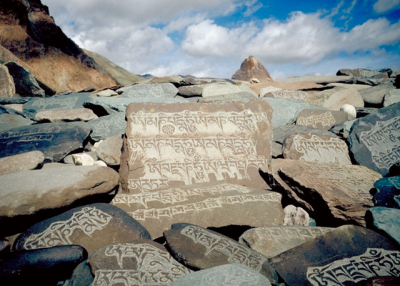
One must begin with a sense of the richness and variety of traditional Vietnamese religion. Time was when the Vietnamese believed they inhabited a world alive with gods and spirits. Little distinction was made between the worlds of the living and the dead, between the human, the vegetable, the animal, and the mineral realms. If fate smiled upon one, nature, too, would be kind; but if one was cursed by fate, then even the elements would be hostile. The stones, the mountains, the trees, the streams and the rivers, and even the very air were full of these deities, ghosts and spirits. Some were benevolent, some were malicious; all had to be conciliated through ritual offerings and appropriate behavior.
So life was regulated by a vast array of beliefs and practices, taboos and injunctions, all designed to leash in these powers that held sway over human life. How much and in what way religion guided one's daily conduct depended on one's background. Confucian scholars, who prided themselves for their rationality, often scoffed at what they considered the superstitious nature of peasant religion. But they, too, were ruled by religious ideas. Different occupational groups had their own beliefs and practices. Fishermen, who pursued a much more hazardous livelihood than the peasants, were notorious for the variety and richness of their taboos. Some beliefs were shared by all Vietnamese. Others were adhered to only in one region or a small locality. Some were so deeply embedded in the culture as to be considered a part of tradition, holding sway over believers and non-believers alike.
If almost everything and everyone possessed a degree of power, so did the words employed to represent them. To a Vietnamese, saying a word out loud was to conjure up the object represented by that word, so that its presence and power became almost tangible. The more awe and fear a certain object inspired, the less often it was talked about, lest its power be called up. Elephants, tigers, crocodiles, and all the animals that threatened the lives of Vietnamese peasants were referred to in whispers, and respectfully called "lords." The personal names of emperors were avoided by all. The incidence of homonyms is quite high in the Vietnamese language, as it is monosyllabic. So in order to avoid using the imperial names to talk about the ordinary things of life, the names of the latter were often slightly distorted. For example, since the 17th century, when the country was divided into the northern territory under the Trinh lords, and the southern territory under the Nguyen lords, Southerners have used the word huynh for "yellow," or "royal," in deference to Nguyen Hoang, the first of the Nguyen lords. For their part, northerners altered the pronunciation of tung into tong for "to submit" or "pine," to avoid pronouncing the name of their own ruler, Trinh Tung.
Ordinary Vietnamese went to great lengths to avoid naming their children after their relatives, dead or alive, for when a name was said out loud, all the people by that name were called up as well. It really would not do when scolding one's child, to be scolding Grandfather as well! The same awe of the power of names made parents call their children, not by their given name but by the order of their birth. But this was done differently in the north and the south.
Northerners were happy to have their first-borns be so known. But Southerners were more fearful of the devil, who coveted the children who were most cherished by their parents. It was thought that this would apply mostly to first-borns, and especially boys. So they pretended that their first-born was only their second child, and the ranking of children began with number two. Even in the 1960s, it was still possible to see small boys dressed as girls, nails painted and ears pierced, in order to fool the devil. This disguise would last until puberty, when parents would feel more confident that their beloved child would survive into adulthood, and when, presumably, it would no longer be possible to mislead the devil. The same reasoning made parents give their newborn babies truly hideous names, for the devil would not be jealous of such obviously unloved children. Then when adolescence was reached, a new and beautiful name would be chosen, to be recorded in the village rolls. Imagine the distress caused by the Western habit of entering permanent names at birth in birth certificates.
Religion governed life before birth, and well beyond the grave. Pregnant women were hemmed in by all sorts of taboos designed to protect them and their unborn child, and to shield others from the power unleashed by this burgeoning life. Expectant mothers were told to eat certain kinds of food and to avoid others, to refrain from doing various things at night, or going to certain places. If, when pregnant, the mother ate crabmeat, it was believed that the fetus would lie crosswise in her womb at the time of delivery. Eating oysters or snails would cause her child to drool. If she took part in a wedding or had herself photographed, her child would be charmless. Neither she nor her husband were to drive nails into their houses, or the birth of their child would be delayed indefinitely. Pregnant women were told to think happy thoughts, and, if possible, gaze at pictures of particularly good-looking children, so that their own child would be beautiful. On no account were they to give birth in someone else's home lest they pollute it beyond repair. They were not to cross fishermen's nets while these were being dyed, or they would bring them bad luck. The only way fishermen could counteract the curse put upon them by pregnant women would be to utter prayers that would cause the women to abort as soon as they reached home.
This is one of the very few instances of ill-wishing towards children. In general, the arrival of a child was cause for great rejoicing. When an infant reached its first full month of life, a great feast was held to give thanks. Another feast was held when the child was one year old. On that occasion, its parents would try to guess its future. Would the child, if a boy, grow to be a scholar, an artisan, a peasant, or a tradesman? That depended on which of the objects representing these four traditional occupations the child picked up when they were set before him. Then life was set, and no more birthdays would be held after that, until one had reached the ripe old age of 60, another time for rejoicing.
In death, one did not pass away. Instead, one passed on to another world, very close still to the land of the living. If one had led a good life, one could pass the merit one had thus accumulated on to one's descendents. Conversely, the progeny of a wicked person would suffer misfortune until all the evil had been expiated. The spirits of the dead could be called back by spirit-mediums, trance-masters, and other religious specialists to give advice to the living. If properly buried and worshipped, the dead would be happy to remain in their realm and act as benevolent spirits for their progeny. But those who died alone and neglected, and to whom no worship was given, disturbed the dead and preyed on the living. In order to appease these restless wandering souls, a grand feast was held on the full moon of the seventh month of the lunar year, the Feast of the Wandering Souls.
For one's ancestor to be particularly beneficial, he (for this applied mostly to male ancestors) must be buried in the correct spot. This necessitated the expertise of a geomancer. He would look at the lay of the land, the relationship between hills, and hollows and streams, and decide which would be the most propitious site. South Vietnam's most famous modern geomancer was known to carry out his field survey from the height of a helicopter, an example of how science and technology do not cause religious beliefs to dwindle away, but on the contrary can serve to strengthen them.
Between birth and death, daily life was regulated by the determination of auspicious dates. Some inherently inauspicious ones were noted on the regular calendar, and applied to all. For example, no one would dream of doing anything of importance on the 5th, the 14th, or the 23rd of the lunar month. If one did think of embarking on a new venture, be it building a house, embarking on a journey, or starting a new business, then it would not be enough to avoid these unlucky dates; a truly auspicious one must be sought. This would require a fortuneteller, who could be an astrologer, a horoscope caster, an I-ching diviner, a palm-reader, or some other expert in the art of reading the future and divining the wishes of the gods. There was a general in the South Vietnamese army who was notorious for refusing to venture out of his headquarters without first consulting his soothsayer, no matter the orders from above or the strategic needs of the moment.
The above sketches of the day-to-day manifestations of traditional religious beliefs only hint at the richness and variety of Vietnamese religion. But these images help serve as a backdrop to the larger question of the role of religion in Vietnamese society and politics. My underlying theme is that both religion and politics are about power, conceived differently to be sure. This shared concern for power has been both a bond and an enduring source of tension between the two throughout Vietnamese history.
The Gods of the Early Vietnamese
Vietnamese religion was a syncretic amalgamation of the three great religions of East Asia—Confucianism, Taoism and Buddhism—onto which had been added a rich variety of preexisting animist beliefs. All Vietnamese believed in this single religious conflation in one form or another, but these forms varied greatly. Scholar-officials gave more weight to Confucian teachings; common people put more emphasis on Buddhism and on Taoism in its popular religious form.
In all probability, the religion of the early Vietnamese before Chinese conquest was totemic. Birds feature heavily in the decoration of the famous Dong Son bronze drums fabricated between the third and the first century B.C. This has led historians to assume that birds were important objects of worship. The early Vietnamese believed that they were descended from a dragon-king who had mated with an immortal from the mountains to produce 100 children. Hence, the recurring dragon motif in Vietnamese decorative art. They also believed that as a people, they enjoyed the protection of the turtle god who appeared at times of national crisis to give the leader of the day the weapons with which to fight off his enemies. The last appearance of this turtle god was in the 15th century when Le Loi, the leader of a guerrilla movement of resistance against Chinese occupation, lost his sword in a Hanoi lake. The turtle god dived into the lake and retrieved the magic sword, thus giving Le Loi the power to throw off Chinese colonial rule and to regain independence for his country. Since then, the lake has been known as the Lake of the Returned Sword.
The mountains and rivers of Vietnam were also endowed with magical properties. The mountain spirit, residing on Mount Tan, near Hanoi, won a contest against the water spirit for the hand of the beautiful princess whom both wanted to marry. Disgruntled, the water spirit attacked Mount Tan by causing the waters to rise, but Mount Tan in return rose ever higher. Folklorists like to point out that this is a mythic reenactment of the monsoon cycle. To the Vietnamese, the legend symbolizes their endurance in the face of harsh elements, and, by extension, their endurance as a people and a nation. The-spirit of Mount Tan keeps a watchful eye over Hanoi where, since the beginning of history, the Vietnamese capital has been located (except under the Nguyen dynasty in the 19th century when it was moved to Hue).
In the wake of the Chinese occupation of Vietnam (111 B.C. to 939 A.D.) came Taoism, Buddhism and Confucianism. By that time, Taoism had lost its original identity as the philosophy of Lao Tzu and his disciples, and had come to refer to magic practices, animist beliefs, and popular religion in general. Geomancers, horoscope-casters, I-ching diviners, fortune-tellers, spirit-mediums, faith-healers, and all sorts of wonder-workers (even those who practiced magic known to be of alien origin), were labelled as Taoist priests. In many cases, these so-called Taoist priests had scant understanding of the teachings of Lao Tzu. Unlike Chinese Taoist priests, they were not organized into a religious organization. Hostile as the Confucian scholars might be to these people they called practitioners of superstition and deluders of innocent people, it was impossible to eradicate them. In a world full of gods and spirits, it was impossible to do without Taoist priests, for through their own efforts at self-cultivation, they held power over these gods and spirits. This power was in their magic, their incantations, their charms and their potions. It was to them that common people turned, for performing the requisite ceremonies at various stages of life, for calling up the dead and healing the living.
As all three religions were introduced into Vietnam at about the same time, Buddhism escaped being singled out and stigmatized as foreign, as was the case in China where Taoism and Confucianism were native religions. Instead it was Confucianism which for a time suffered from being considered as the ideology of the occupying forces and of the educated but Chinese-influenced local elite. The kings who ruled Vietnam after independence (939 A.D.) came from a background entirely different from that of the Confucianized elite who had collaborated with the Chinese occupiers. They rose to power on the strength of their armies and of their personal wealth. Issued from landed families, with no pretension to knowledge, they admired force and despised scholarly softness. In the aftermath of independence, their hold over the country was tenuous, often challenged by other landed clans with large armies. Thus, their control did not extend greatly beyond the capital and the surrounding countryside, but where it was exercised, it was absolute, untempered by laws and regulations. One early king had a huge cauldron of boiling oil and a cage full of hungry tigers set in the middle of his palace courtyard to frighten his courtiers into abject subservience and to instill prudence into would-be challengers to his rule. Despite such precautions, however, he and his heir were assassinated by a man who had dreamed he was destined to be king and proceeded to act upon that prophetic dream. Except that the dream did not come true, for he, in turn, was killed by a supporter of the dead king.
Dreams, omens, prophecies shaped the behavior of the early Vietnamese, for rulers and subjects alike were always anxious to placate the gods and spirits who held sway over human life. Early Vietnamese religion thus was essentially propitiatory and lacked an ethical, moral dimension.
Buddhism: Compassion and Salvation
What helped soften the arbitrary and sometimes brutal character of this early despotic rule was the influence of Buddhism.
Already in the second century, Hanoi was known as a center of Buddhism. Vietnamese Buddhism emphasized mental and physical self-discipline and proper conduct, instead of the painstaking acquisition of doctrinal knowledge. Sudden, rather than gradual, enlightenment was the ultimate goal. This orientation left Vietnamese Buddhism open to the influence of religious Taoism and of magic. The Vietnamese of the 10th century could be devout Buddhists without relinquishing any of their animist beliefs.
Still, as a Buddhist monk, one had to have a modicum of learning in order, to read the Buddhist scriptures. Aside from the Confucian scholars, temporarily out of favor because their loyalties were suspect, the Buddhist priesthood was the only other source of literate people. They could thus be called upon to assist the powerful but uneducated ruler and his equally uneducated courtiers. To the early kings, always fearful of being deposed by rival clans, the fact that monks severed all family ties as a prerequisite for entering the religious life could only come as a relief. Monks were educated, they did not covet the throne, and gave advice when wanted. No wonder the Vietnamese kings turned to them.
As the kings consolidated their hold over the country, they used Buddhism as a symbolic representation both of the royal presence and of national integration. In the 11th century, a king ordered that temples be built in every village. Close to 1,000 were thus erected. When another king gave two of his daughters away in marriage to chiefs of highlands tribes, he also decreed that temples be built so that he could be accommodated there when visiting his daughters. These temples were to be more than hostels; they were to serve as reminders of the reach of the king and as means of extending court culture into the highlands. In one famous case a royal concubine, who had disposed of the rightful queen and all her 70 ladies-in-waiting by entombing them alive, was seized by remorse later on in life and built 100 temples throughout the land to expiate her sins. Like the medieval European nobility, Vietnamese aristocrats tried to gain absolution for their misdeeds by becoming patrons of religion -- sponsoring monks, building temples, and endowing them with lands and lavish gifts.
With the consolidation of royal power, the disadvantages of relying on Buddhism for political purposes became more apparent. The most obvious shortcoming of Buddhism was its essentially other-worldly orientation. Buddhism was fundamentally uninterested in the here and now, which is the chief concern of politics. How then, could monks play an active role in politics? Their role was made possible through an ingenious interpretation of the Buddhist notion of salvation.
In the countries of Southeast Asia where Theravada Buddhism is practiced, salvation is the non-transferable reward of an individual's efforts to achieve Buddhahood. But Vietnamese Buddhism, as in East Asia, belonged to the Mahayana stream which allowed for collective as opposed to purely individual salvation. In Mahayana Buddhism is the notion of bodhisattvas, beings who have already achieved salvation. But just as they are about to enter nirvana, they look back upon the world and are moved by compassion for the sufferings of mankind so that, instead of entering nirvana, they descend again into the world to work for the salvation of mankind. One Buddhist text states that it is the duty of bodhisattvas to assist the ruler of a country by becoming his advisors. When taking an active interest in political matters, Vietnamese monks could draw inspiration from this Buddhist scripture. Under the influence of monks, rulers tempered harshness with compassion, issuing amnesties to criminals on royal occasions and at Buddhist festivals. But some monks became involved in military affairs as well, and for that, there was no scriptural justification.
But valued though the monks were as advisors, they still could not compensate for the inherent deficiencies of Buddhism as a state religion. For although the salvation doctrine of the Vietnamese Buddhists rationalized social commitment and political activism, it provided no real guidance for the exercise of power, nor for its delegation. And despite its apolitical orientation, which so attracted the rulers, it could unwittingly undermine the authority of the throne. When monks distributed grain to needy peasants, they competed with the state and its representatives for legitimacy in their eyes. The very notion of compassion in politics came under attack. Confucian scholars argued that amnesties made nonsense of the law, for they introduced into its application an element of arbitrariness. And in pardoning an enemy of the state and letting him go free not just once, but several times, a Buddhist king of the 11th century had subordinated the interests of the state to the dictates of religion, an unforgivable breach of his duty.
The size and power of the clergy became a source of concern. The sheer number of monks made the priesthood a cohesive force, capable of influencing the course of events. For example, Ly Cong Uan, the founder of the Ly dynasty (1010-1225) came to the throne with the support of the Buddhist clergy. As he had been raised in a monastery, the monks reasoned that he would pursue much more sympathetic policies towards them than the king whom he replaced. Indeed, the Ly dynasty was an era of unmatched prosperity for Vietnamese Buddhism.
When entering a monastery, monks and nuns disavowed society's claims on them, including the claims of blood ties. The common expression for the act of joining a monastery was "to leave the world." Monks and nuns thus proclaimed themselves to be outside the realm of the king's subjects, outside the reach of his laws, and to be ruled by a power higher than the king. The only laws they would live by were the laws of the monkhood or vinaya. In China, these claims had attracted the censoriousness of rulers and Confucian scholars, and criticism turned into persecution. In the early days of independence, no Vietnamese scholar felt strong enough yet to attack Buddhism head on, and the rulers were both too devout and too dependent on the monks to resent their claims. But by the end of the 12th century, efforts to curb both the size and the power of the clergy were underway.
The example of Ly Cong Uan reveals that for poor Vietnamese, one path to mobility ran through monasteries, where some education could be gained. Not all who joined monasteries, however, did so in order to receive an education, or out of religious commitment to seeking salvation in the afterlife. Economic considerations played an enormous role. For in renouncing the claims of society, monks also rejected the financial burdens of being a common subject of the king. Indeed, one Confucian scholar thundered in 1198 that there were as many tax-exempt monks as there were ordinary taxpayers. Monks avoided corvee labor and military service as well. So did the slaves, serfs and tenant families employed on the estates belonging to Buddhist temples. The origins of the temple slaves lie in Indian Buddhism, which forbade monks to engage in manual labor in order to use all their available time in purely religious activities. Thanks to constant donations from devout kings, nobles and commoners, the temples were lavishly decorated with gold, precious stones and metals, which, Confucian scholars of the day pointed out, could have been better used to fabricate agricultural implements and weapons, or simply used as currency. Furthermore, neither the very extensive lands attached to the temples, nor their products could be taxed.
According to these scholars, one proof that people did not enter monasteries out of sincere religious commitment was how ignorant of the Buddhist scriptures the average monks were. In response, Vietnamese kings instituted regular exams. Those who failed were defrocked and returned to the ranks of tax-paying commoners. That scholars could attack Buddhism with such vigor was a sign that Confucianism was in the ascendancy. Buddhism remained an important influence both among common people and among members of the court, but never again after the 13th century would it play an important political role.
Confucianism: Heaven, Emperor, and Man
Across the Perfume River from the imperial palace that the Nguyen kings built in Hue, stands the seven-story pagoda of the Heavenly Mother. Built in 1601, it is the last large-scale monument dedicated to Buddhism. Despite the fact that it was the ancestors of the Nguyen dynastic founder who ordered its construction, it was this dynasty which saw the triumph of Confucian orthodoxy.
It is easy to contrast the here-and-now orientation of Confucianism with the other-worldliness of Buddhism. Confucianism is often thought of merely as a code of ethics and as a philosophy of government based on merit, which made possible the rise of bureaucratic rule in the countries of East Asia, curbing both the power of the ruler and of the aristocratic clans. Education, rather than brute force, became the path to power. Merit, that is to say suitability for governmental service, was determined through a system of civil service examinations testing a candidate's knowledge of a body of canonical texts -- the Four Classics and the Five Books. Suitability for office was determined by one's ability to write essays on literary themes, historical topics and current events according to rigid rules (for instance the rules governing avoidance of imperial names). A superior man was a man with a broad education, not an expert in a specific field. Furthermore, a stringent code of ethics guided the behavior of all from king to commoner, providing clear rules for their daily relationships and the ordering of society.
What needs to be underlined is the religious dimension of Confucianism. Confucian scholars, and many Western observers after them, may have emphasized the rationalist, humanist, and rather prosaic dimension of Confucianism. But it was founded on a base of religious assumptions, no less strong for being unstated. Since the 11th century, the emperor had assumed the role of First Plowman. He launched the agricultural year by plowing the first furrow, a ceremony that was maintained in Vietnam until 1942, three years before imperial rule came to an end in revolution. This was one of many such religious duties to be performed only by the emperor.
Ancestor worship and filial piety were the cardinal virtues that governed the lives of all. When still only a pretender to the throne, the eventual founder of the Nguyen dynasty, Gia Long, allowed his heir to be converted to Catholicism as a means of gaining support from Christian missionaries. The young prince was so thoroughly converted to Catholicism that he refused to perform the all-important rites of worship to his ancestors. Gia Long complained that not only his heir but also a great many of his courtiers refused to perform the rites that were a necessary part of court life. How would the court function if no one was left to carry out these ceremonies? Fortunately, the young Christian prince died before his father, allowing the succession to go to a half-brother who had been brought up in the strictest Confucian tradition. The calamity of having on the throne an emperor who would not perform the religious duties that went with his imperial functions was thus averted. Had the Catholic prince inherited the throne, not only would court life have been brought to a halt, but the well-being of the whole nation would have been jeopardized as well, for the emperor was the Son of Heaven. To him, and him only, devolved the duty to mediate between Heaven and man, and to ensure the welfare of his people by acting according to Heaven's will in all things, political as well as personal. If he sinned in any way, Heaven might choose to punish him by visiting disaster upon his people. Thus, any calamity, any instance of misfortune was interpreted as a sign of Heaven's displeasure with the emperor.
Gia Long's great-grandson, Tu Duc, ascended the throne by edging out his two older brothers. Not unnaturally, both were incensed and rebelled. For reasons of state, Tu Duc was forced to put them to death. But to kill one's brothers, especially one's older brothers, was to go against the most basic Confucian ethics. No wonder that Tu Duc, faced with the threat of colonial conquest, blamed himself for visiting misfortune upon his people. Believing himself solely responsible for this calamity, he dealt with the French threat with a heavy dose of fatalism that perhaps sealed the fate of his nation. French rule over Vietnam lasted for eighty years.
Tu Duc's acceptance of responsibility for the national calamity underlined the Confucian idea that only the emperor had religious duties. As his representatives, officials shared in these functions, performing at the local level ceremonies which the emperor performed in his court. It was feared that if common people were to usurp these religious powers, only evil spirits would answer to their call, and disorder would reign throughout the land. All that common people were expected to do was to support the emperor and his representatives by paying taxes and being loyal and obedient subjects.
Obviously, it was impossible to enforce such an ideology which deprived common people of any religious role. Confronted with the ineradicable nature of popular religion, the state tried to make use of it for its own ends. One particular area of concern was the role of religion at the village level.
God and Caesar in a Vietnamese Village
There is a Vietnamese saying which likens the village to a smaller version of the imperial court. In thinking about village religion, it is useful to bear this image in mind, for religion functioned within the village in the same way as it did at the imperial court, providing the oil which smoothed its operations.
Village affairs were conducted in the communal house, where all official documents pertaining to the village were deposited. These included village census rolls, tax and land records, and the all important village by-laws. The existence of these bylaws, a mixture of administrative rules, customary laws and religious guidelines, has led observers to give credence to the saying that the laws of the king must bow before village customs. In reality, these by-laws were always scrutinized by officials to make sure that they did not go against the spirit of imperial laws. Villages were far less autonomous than the popular saying would suggest.
As the nation had its patron deities—the dragon-king and the turtle god—so had each village its own deity responsible for the well-being of its inhabitants. Sometimes the village god was its founder, but it could also be a particularly famous former inhabitant or a locally-recognized deity. The state exerted control over village religion by investing village gods with its stamp of approval. Thus graciously granted recognition, the god was enthroned in the national pantheon of deities to whom it was permitted to give worship. It came as a shock to 19th century officials that in one village, the inhabitants had chosen a thief as their village god, and in another, a famous rebel. In still another, the village inhabitants had chosen a woman of dubious morals. Religion was too important for peasants to exercise their whimsy. It was the officials' duty to persuade them to choose a more suitable object of veneration. Then there was the vexing question of local cults, in particular fertility rites, which made peasants behave in ways definitely not sanctioned by Confucian ethics. Not to mention the pervasive presence of Buddhist pagodas and Taoist temples, and the possible subversive activities of various practitioners of popular religion. But all this exercised the ire of state officials much more than the peasants. What tore Vietnamese communities apart was Christianity's challenge to village religion.
Just as the court could not function without the proper religious ceremonies, no village affairs could be conducted without the proper worship to the village god. There existed a religious council in each village to ensure that ceremonies were carried out properly. What happened then, when some members of the village did not subscribe to the same religion as the majority of their fellow villagers? What happened if some refused to worship the village god? The court had been spared the dilemma when the Catholic crown prince died. But for many villages, there was no avoiding a confrontation. The Catholic religion expressly forbade the worship of false idols. So how could Vietnamese Catholics participate in village life which always began with the requisite rites to the tutelary god? Either they must be barred from doing so, or else village life would have to be restructured in a fundamental way. Another vexing issue was the authority of the parish priest which took precedence, in the eyes of his flock, over the authority of the village council.
The easiest way out of this dilemma was for Catholics to secede from their native villages and establish new ones under the leadership of their parish priests. Often, the new villages existed side by side with the original ones. Sometimes, however, the priest led his parishioners into uncultivated areas and founded entirely new communities. In these overwhelmingly Catholic villages, it was possible for the Vietnamese Christians to lead their lives according to the dictates of their faith. However, resettlement did not end friction with non-Catholic communities nor with the state, for not only did Catholics refuse to acknowledge as ultimate authority either the village god, or the emperor, they also did not worship their own ancestors, a sign of moral turpitude. Instead they worshipped a cross upon which was nailed a half-naked man, and they believed in the most extraordinary nonsense. At least, so it appeared to Emperor Minh Mang (1820-1840) after he conscientiously perused the Bible:
This Western book says that in the age of Yao there was a flood. Their country' s prince used one great ship and took all the people and birds and animals within the country and fled to occupy the inaccessible top of a high mountain. [The book] also says that at the time of this flood within their country there only existed seven people. Later the people daily increased but all of them stemmed from the ancestry of these seven people. Such a theory is truly unfounded [The book] also says that their country had one prince who led the people of the country to manufacture and erect a heavenly pagoda. Its height was goodness knows how many thousands of truong and he wanted to climb it and roam the heavenly palace in order to examine conditions in heaven. The emperor of heaven was afraid and immediately ordered heavenly bureaucrats to come down and change their tones [languages], causing them to be unable mutually to work together. Hence they were unable to complete their pagoda. That every place in their country now has different languages and customs is attributed to this. This theory is even more irrational.
Throughout much of the 19th century, Catholics were persecuted, for the alien nature of their beliefs, for their insistence on putting God above the emperor, and for their suspected links with the foreigners who threatened Vietnamese independence. Catholics were the victims of the most extreme efforts at suppression, but others also suffered, as the state asserted as never before its claims to ultimate religious and political authority.
Religious Vehicles of Dissent
One method of enforcing orthodoxy applied mostly to Buddhism. It consisted of imposing bureaucratic control over the organization and size of the Buddhist clergy through the supervision of doctrinal exams and ordinations into the clergy; limiting the number of temples that were built and the amount of land they were given; and manipulating the distribution of cultic and scriptural materials that were channeled through the court. Taoist priests, not being organized, were much less amenable to this form of control. But the more the state tried to enforce orthodoxy, the more it invited challenges from more traditional quarters, challenges which could be open, taking the form of rebellion, or merely implicit. The state's concern over the link between religion and rebellion was far from fanciful. In times past, Buddhist monks and Taoist priests had been known to lead movements of rebellion. Monasteries were still being used as places of refuge by rebels against the throne. This was one powerful reason behind the efforts to regulate Buddhist monasteries in the 19th century. It was easy enough to limit the number of ordained monks, and to defrock those who did not meet the standards set by the officials. However, given the limited resources of the traditional state, it was harder to prevent people from pursuing a religious life in places where the state did not penetrate. Such was the case of the southwestern frontier, a pioneer region through much of the 19th century, a meeting ground for various ethnic, cultural and religious groups, and thus a fertile place for heterodoxies to flourish.
For reasons that are not clear, Catholic missionaries were not successful in attracting converts in the south before the colonial period. Most of the Catholics who were in South Vietnam in the 1960s were refugees from the north, or had become Catholics during the French colonial period. The brand of heterodoxy that flourished in the south in the 19th century was thus a product of Vietnamese popular religion, a mixture of Buddhist, Taoist, Confucian and animist beliefs. What distinguished this heterodoxy from the state religion was partly the prominence of Buddhism and Taoism over Confucianism, and partly a fundamentally different world-view. Confucianism was at base optimistic; life was good, nature was kind. This view was a logical outgrowth of the idea that the emperor's rule was benign and beneficial. Vietnamese religious dissidents, on the contrary, held a much more pessimistic view of life. Theirs was an apocalyptic vision of history.
According to this interpretation, the cosmos evolved in series of cycles. Each of these cycles included a phase of prosperity, decay and ruin. At the end of each cycle, when ruin, disasters and wickedness had taken over, there would be an apocalyptic event, a flood perhaps, or a cosmic conflagration, or a huge typhoon. It would engulf the world and cleanse it of evil. All wickedness would disappear, and only what was good and virtuous would remain. The forces of the cosmos would rearrange themselves in a new "creation of Heaven and establishment of Earth" (tao thien lap dia), and a new era of peace, prosperity and virtue would begin. It was believed that our present era, ruled over by the historic Buddha Gautama, was about to end, and that it would be replaced by the era of Maitreya, the Future Buddha.
Maitreya was a popular figure of worship throughout the history of Vietnamese Buddhism. In the Temple of the Heavenly Mother in Hue stands a huge statue of him. Until the 19th century, he embodied hope rather than despair. He symbolized the aspirations of Vietnamese Buddhists for salvation and rebirth in his Pure Land. Even though predictions of an impending apocalypse had surfaced many times over the centuries, the Maitreya ideal was not linked to the fear of apocalypse. In the 1850s, however, a new religious movement was founded on the claim that the apocalypse was about to come, and that all wickedness was to be destroyed. Then, the Buddha Maitreya would descend to usher in a new millennium of peace and prosperity. The exact location of his descent was to be a desolate hilly area near the Cambodian border in southwestern Vietnam. Those who wished to strive for salvation and rebirth in the reign of Maitreya were to gather there to cultivate themselves and lead a good life. The new religious movement became known as Buu Son Ky Huong or Strange Fragrance from the Precious Mountain. The name of the movement was meant to refer to the fact that Maitreya was expected to appear in the Seven Mountains of Chau Doc province (hence the idea of a Precious Mountain) and that he would preach a new Buddhist doctrine, likened by the believers to a strange fragrance.
Southwestern Vietnam in the 1850s was pioneer territory with a sparse, but mixed population. The Vietnamese there were in the minority against both Cambodian natives and Chinese immigrants who had poured into the area in a steady stream since the turn of the century. Among the Vietnamese were people who had come in search of a better future. But there were also many defrocked monks from other regions, as well as people who were considered undesirable by the authorities of their native places and had been sent into exile to this frontier. The Vietnamese population in this region was thus adrift from its cultural moorings, for traditional village structures had not yet acquired solid foundations, and few representatives of the state were in evidence.
What the Buu Son Ky Huong movement had to offer to these pioneers, dissidents and rebels was an ideology of moral, social and cultural integration, an ideology that made sense of their hardship and of their experiences, and provided them with hope for the future. This ideology was presented as a return to the original purity and simplicity of Buddhism. Observing the teachings of the Buddha in one's daily life would be the only path to salvation, not the mindless utterance of prayers, not costly offerings and elaborate ceremonies. It was thus a reaction to the rigid monasticism of 19th century Buddhism. It was an ideology that celebrated hard work and frugality, that did not distinguish between rich and poor, that was family-oriented rather than congregational or monastic. It was thus tailor-made for its pioneer following.
Despite the sect members' self-image as orthodox Buddhists, their leaders tended to be practitioners of popular religion—faith-healers, soothsayers, and Taoist priests whose occupation gave them power over the world of spirits and put them in contact with a wide variety of people. Even the Buddhist monks among them did not belong to mainstream Buddhism. The leaders spearheaded the creation of new villages where the sectaries would be able to live according to the beliefs and practices of their sect while waiting for Maitreya's descent. They believed that all the hardships they suffered, battling wild beasts and inclement nature and enduring the ravages of unrest and periodic wars between Vietnam and Cambodia, prepared them for rebirth into the perfect world of Maitreya. All else would perish. The myth of the millennium was thus a powerful incentive to attract pioneers and to give them the courage to remain in this inhospitable region. At the same time, the religious teachings of the sect fostered a sense of community that overcame the absence of long-standing village institutions and kinship ties.
No more than the Catholics of the north did these unorthodox pioneers openly challenge the authority of the emperor. They sought above all to remain in the margin of mainstream society, free of official interference. But even as they believed themselves to be loyal subjects of the emperor, they put Maitreya—and the prophets who claimed to be the reincarnation of Maitreya—above him. That in itself made them vulnerable to suppression as heretics. But while the Catholics, linked in the minds of the officials with the Westerners, came under increasing persecution, the sectaries of the southwest were valuable allies of the state as settlers of the disputed frontier area. The state thus chose to leave them alone.
The sectaries became involved in the anticolonial movement soon after French conquest. It was the first time that their apocalyptic vision had led them into political militancy. In their calculations, the apocalypse loomed nearer, and the need to use violence against the established order as a prelude to the birth of the new millennium became more urgent. Not surprisingly, the French banned the sect, but were unable to eradicate it completely. Its roots were established firmly among the population of the southwest, and were able to survive into the 20th century.
One reason why the Buu Son Ky Huong sect was able to outlive repeated persecution was its essentially family oriented nature. It had a minimum of organizational structure. It was a way of life more than an organized movement. Only when they rebelled did the sect members join together, for congregational worship was rare. Partly because of this characteristic, partly because of earlier suppression, the survival of this millenarian tradition went largely unnoticed in the first few decades of the 20th century, a time when secular political parties made their first appearance in Vietnam. Of these the Communist party was the most successful and visible, as well as the chief target of repression by the colonial state.
Hoa Hao: Religion and Politics
That the millenarian tradition of the Buu Son Ky Huong sect had endured and even flourished was demonstrated spectacularly in 1939 when a 20 year-old youth named Huynh Phu So founded the Hoa Hao sect. A native of the southwest, Huynh Phu So capitalized on the millenarian beliefs, claiming that he was the reincarnation of the founder of the Buu Son Ky Huong sect and that his mission was to bring the tradition back to its original purity. He reactivated the myth of the millennium, predicting that the end of the world would come within a few years. In a few months he gained thousands of followers. Over the period of World War II, he gathered nearly one million followers who were fanatically devoted to him.
Huynh Phu So stressed virtue in one's daily conduct as the chief method of seeking salvation, for over the years, the tendency to stage elaborate ceremonies with expensive offerings to Buddha had taken over, and with it the reliance on prayers rather than good deeds. Religion, he said, was to provide the guidelines for all activities. It was not enough, furthermore, to seek salvation for oneself only. In this era of imminent apocalypse, collective salvation was the ultimate aim. Religion should not stay separate from political matters; on the contrary, religious people had the duty to become politically involved since both politics and religion were concerned with salvation. To those who accused him of politicizing religion, Huynh Phu So replied that he was bringing religion into politics, as was right and proper. His Hoa Hao sect was thus not only a religious movement, but a political one as well, with a formidable mass base made up of nearly one million peasants, mostly located in the southwest and the Mekong delta. When World War II ended and the Japanese surrendered to the Allies, the sect refused to accept the leadership of the communist-dominated Viet Minh coalition. In 1947, Huynh Phu So was assassinated by Viet Minh agents, and his followers became implacably opposed to the Viet Minh. This hostility lasted through the Vietnam War, although some Hoa Hao members turned to the National Liberation Front (NLF) after the South Vietnamese government of President Ngo Dinh Diem crushed an uprising in which the sect had taken part, and disarmed it.
The Buu Son Ky Huong and Hoa Hao sects made the most explicit refutation of the traditional Confucian state's contention that the political order must prevail over all areas of life, and of its claim to determine what role religion should play in the lives of ordinary Vietnamese. Essentially the two sects took a completely opposite view of the relationship between religion and politics. Both the sects and the state, however, were agreed about the fundamentally inextricable nature of this relationship.
The Hoa Hao sect illustrates a reformist, purifying strand in popular religion. Historically, such reformist movements periodically appeared in reaction to the inherent tendency of popular religion towards excessive eclecticism. The latter tendency is well illustrated by the other major political-religious sect of southern Vietnam, the Cao Dai sect, which was founded in 1926, 13 years before the appearance of the Hoa Hao sect.
Cao Dai: Something for Everyone
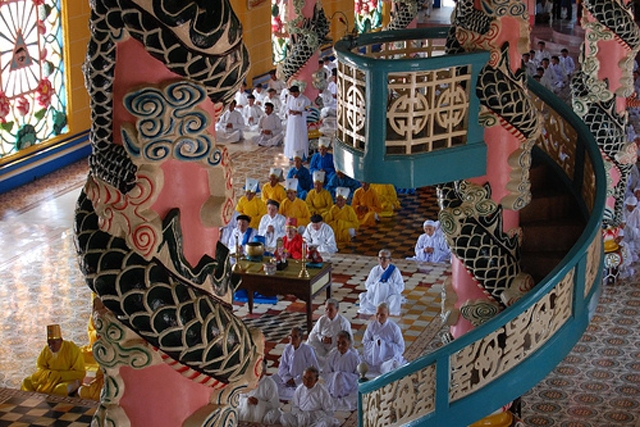
Caodaism was not only an exuberant blend of Taoism, Buddhism, Confucianism and popular cults, it also aspired to be a universal religion by virtue of incorporating into its pantheon Jesus Christ and various figures from Western history, whose only connecting link was their claim to have had direct communication with God. The most important aspect of its doctrine was a belief in a Supreme Being or Cao Dai who made his wishes known through the agency of teen-age mediums. The eclectic nature of the Cao Dai teachings was reflected in its architecture and in its organization. Whereas the Hoa Hao sect remained family-oriented, and thus did not necessitate the construction of temples, the Cao Dai religion was congregational. The sayings of Cao Dai were transmitted to the faithful in oratories. The most important of these oratories was the Holy See in Tay Ninh province. Its structure was borrowed from the Catholic cathedral of Saigon, but its decoration was a product of Vietnamese popular religion at its gaudiest. Ubiquitous among this decoration was the Heavenly Eye represented by a very naturalistic picture of a human eye, and symbolizing the omniscience and omnipresence of Cao Dai. On the wall fronting the entrance was a large mural depicting Victor Hugo, Confucius and Sun Yat-sen, a painted symbol of the mixed origins of the Cao Dai beliefs.
Cao Dai organization was as eclectic as its architectural style, and as complex as its pantheon of deities. Whereas the Hoa Hao sect had no institutional infrastructure until after World War II, the Cao Dai hierarchy was well developed. There were three different hierarchies made up of Confucian, Taoist and Buddhist followers, divided into nine grades. Furthermore, the structure of the sect was composed of a council of mediums, an administrative organ and a body overseeing the operation of charitable agencies serving as recruitment organs. To further complicate matters, male and female dignitaries of the sect were organized separately.
Although the majority of the faithful were peasants from the southeastern provinces of Vietnam, the leaders came mostly from the ranks of colonial civil servants and landowners. In creating a new religion in which Christianity was but one strand, they were trying, in the words of Alexander Woodside, to find equivalence with the West. In organizing the sect as they did, they were also trying to be all things to all men.
In trying to characterize the Cao Dai religion, the words adaptability and inclusiveness come to mind. Whereas the Hoa Hao sect under Huynh Phu So was rigid in its religious and political claims, the Cao Dai sect proved much more flexible. It avoided open conflict with the Viet Minh, while maintaining control over its territory. But in 1955, it too took part in the unsuccessful confrontation with President Diem, and it too was forced to give up its military role. Many of the sectaries, who had no memories of conflict to embitter their relations with the communists, were able to make common cause with them and to join the NLF.
Conclusion: Religion in an Atheist State
Religion affects the lives of ordinary men and women on many different levels. It provides them with moral guidelines, it gives meaning to their existence and to the world they inhabit. It gives them solace and hope for the future. As in 19th century Vietnam, religion can inspire them to build new communities that embody their vision of the perfect world in the most desolate places. The claims of religion need not be in conflict with the claims of the state. Throughout history, religion served both to integrate the Vietnamese people into a cohesive society and to reinforce the presence, if not the power, of the emperor while softening his rule. But it also served as a refuge for those who wanted to escape this rule, and as a vehicle of dissent for those who rejected the all encompassing claims of the state. In their turn, dissenters could, on behalf of their religious beliefs, present claims as sweeping as those made by the state on behalf of politics, and be as intransigent with those who disagreed with them.
The communist state is in many ways heir to the Confucian state. This is evident in the social origins of much of its leadership. Like its Confucian predecessors, the new leadership has made a rigorous attempt to control the religious life of its population, only with the aid of a new state orthodoxy, Marxism-Leninism. The leadership insists that the Vietnamese Catholic church be a national church. It has ordered the confiscation of properties belonging to the Buddhist church, including schools and orphanages, on the grounds that the state alone should run such institutions. It refuses to allow draft-age males into the ranks of the Catholic and Buddhist clergies. Not unsurprisingly, these attempts at state control have provoked a reaction. Although the Communist party is securely at the helm, its leaders are taking no chances. Periodic appeals for vigilance against enemies of the state continue to be issued. Chief among these suspected enemies are members of the Cao Dai and Hoa Hao sects, as well as Catholics and Buddhists. The modern state has greater powers, and much more effective means of control than the traditional state ever possessed. It is conceivable that the communist state will succeed where the Confucian state did not. But religious aspirations are too strong to be uprooted easily.
The outcome of the centuries-old tension between state and religion is very much in the laps of the gods.
Further Readings
Gerald Cannon Hickey, Village in Vietnam, (New Haven: Yale University Press, 1964).
Thich Nhat Hanh, Vietnam: The Lotus in the Sea of Fire, (London: SCM Press, Ltd, 1967).
Hue-Tam Ho Tai, Millenarianism and Peasant Politics in Vietnam, (Cambridge: Harvard University Press, 1963).
Lawrence Thompson, Chinese Religion, An Introduction, (Encino California: Duxbury Press, 1975).
Huynh Sanh Thong, trans., The Tale of Kieu, by Nguyen Du, (New Haven: Yale University Press, 1983).
C.K. Yang, Religion in Chinese Society,(Berkeley: University of California Press, 1967).
Author: Hue-Tam Ho Tai.