
Lessons for Korea from the Financial Crisis
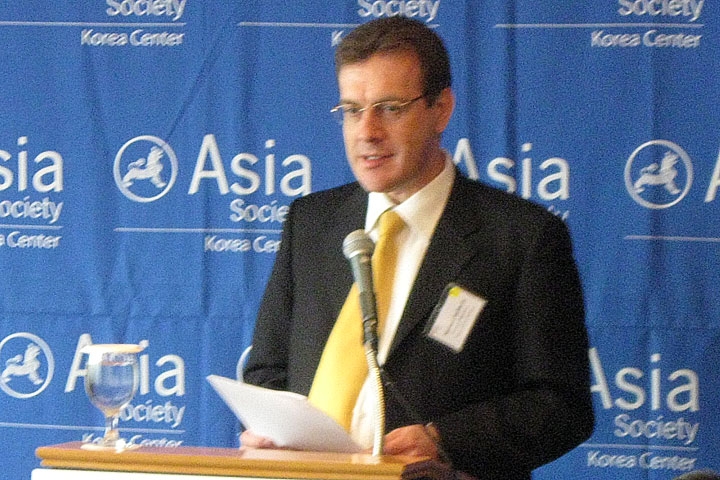
SEOUL, April 20, 2010 - Speaking at the monthly Asia Society Korea Center luncheon here, Branch Manager and Chief Operating Officer of Deutsche Bank (DB) Korea and chairman of the Foreign Bankers' Group (FBG) Michael Hellbeck delivered a carefully qualified defense of the financial industry, while also acknowledging the obvious shortcomings that helped create the recent worldwide economic collapse.
Standing before an attentive audience of finance professionals, diplomats, academics, journalists, and businesspeople, Hellbeck took pains to point out that he was speaking not as the head of DB in Seoul but as a private individual. It was clear, however, that his approximately 13 years of experience working in Korea for the German financial giant have given him the insight to address the day's topic, namely "Lessons Learnt from the Global Financial Crisis: Impact on Korea."
Hellbeck began by recapitulating the causes of the crisis: high liquidity, too much optimism, not enough assessment of risk, and low interest rates on borrowed money. These led to a collective search for investments with higher yield that wasn't commensurate with the higher risks taken. Furthermore, investment banks began to pitch more complex financial products that many ordinary people struggled to understand, and this happened within a negligent supervisory framework. In spite of the lax oversight, though, Hellbeck said that overall financial institutions should take the lion's share of the blame, because they "should have known better."
As to the lessons learned from the crisis, Hellbeck saw a consensus that the world financial system should be reformed so as to withstand shocks better. That means two things in particular: a risk management system and financial supervision. He stressed that the latter was to be of a "macro/prudential" nature, rather than a "micro/institutional" nature.
The most urgent requirement, according to Hellbeck, is a globally harmonized system of rules and consistent implementation thereof. Otherwise there will be regulatory arbitrage—a situation in which financial institutions will choose to operate in jurisdictions where the rules are less strict and less enforced, as international ship owners do when registering their vessels.
Contrary to a commonly-held opinion that big banks are bad, Hellbeck claimed that little or no evidence supports this theory, and that many small banks also made mistakes and failed.
Next: The relevance for Korea, and Michael Hellbeck's lessons for ordinary investors
There must also be a discussion of laws and systems to keep savings and trading banks separate to preserve customer deposits. This is no solution, he explained, because if so-called "casino banks" are large enough, their collapse or failure would also affect the whole economy.
Hellbeck added that capital requirements seem like an obvious step, but financial institutions must be given time to build them up, and they must be globally consistent. (In this context, he stressed, the G-20 financial conferences are important to building consistency, and to avoid a repeat of regulatory arbitrage.) However, too much focus on regulatory capital misses the bigger picture of liquidity problems and balance sheet weaknesses.
Hellbeck defended securitization models, saying that although they have been demonized in the public eye, if used well they are good. He gave the example of companies borrowing against future cash flows, such as airlines do with receivables. But where it can become a problem is with multi-layered securitization products like sub-prime mortgages. The ratings agencies do not care who the borrower is or their credit rating, just the value of the underlying asset. Ratings agencies must therefore take part of the blame of misleading consumers.
Hellbeck also said that nothing in principle was wrong with hedging through credit default swaps, but that this gets lost through the public debate.
Regarding compensation standards for the finance industry, Michael said that it has been convenient for banks for blame each other for ever-increasing salaries, but that governments and regulators must break that cycle.
Turning to the relevance of all this for Korea, Hellbeck pointed out that there was almost no collateral damage from toxic assets in Korea, except at Woori Bank. Most Korean financial institutions did not lose money from the global financial crisis, he said. But KIKO (knock-in knock-out) currency option contracts have led to many lawsuits, and there is debate in the courts now.
Korean banks had relatively modest leveraging because they learned their lessons from 10 years ago (druing the Asian financial crisis, commonly known in Korea as the IMF crisis) and now they have better risk management systems and practices. As a result of that experience, Korea has built a more resilient financial system.
However, what shocked Korea was the quick out- and in-flow of US dollar capital investment. In late 2008 this was a global phenomenon, and Korea was no exception. But it gave a shock to the Korean government, and they have since been working to counter this effect. Hellbeck stated that he does not agree with resorting to capital controls, which he characterized as "tempting but destructive." The better way, he argued, is to create a capital friendly environment to attract and keep investment here.
Hellbeck hopes that the G-20 meeting in Seoul in November 2010 will result in a coordinated, consistent approach that improves the financial situation in all countries.
A final lesson that Hellbeck offered is that he doesn't recommend retail investors get into complex financial products. Instead, he advised people to buy something that they understand, that is liquid, and to diversify risk. He told the audience to be wary of fund structures that lack transparency—to understand fully what it is that they are buying, not just to buy what is popular (as often happens in the Korean non-institutional investment market). Extra yield is not always commensurate with the risks that are taken.
In the ensuing Q & A session, businessman Tom Coyner asked Hellbeck whether ethical considerations in financial institutions are being taken more seriously, post-crisis. Hellbeck answered that banks look for loopholes to find ways to make money, but at the same time he believes that all financial institutions have learned their lessons from the recent catastrophe. Hellbeck cautioned that ultimately it's hard to make a general comment about ethical issues because those decisions inevitably come down to individuals.
French journalist Sebastien Falletti asked what issues might be "deal breakers" for the upcoming G-20 forum. Hellbeck replied that there was already substantial agreement surrounding technical debates, but not with regard to populist issues (such as compensation practices), and these are the ones that often attract the heat of negative media attention. Overall, though, he said he saw real hope for new global standards and measures in the financial industry.
And on that optimistic note, the April luncheon lecture came to an end.