
Author Peter Hessler on the Open Road in China
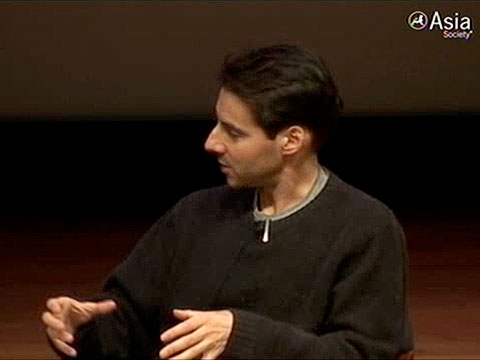
NEW YORK, February 9, 2010 - Imagine following a wall across a country. Following a childhood dream, journalist Peter Hessler embarked on a road trip across China, from the cities into the interior, from farms to factories. The result is Country Driving: a Journey through China from Farm to Factory, part reportage and part memoir, a culmination of his eight-year stay in China.
A former Beijing correspondent for the New Yorker, Hessler was based in China for a nearly a decade and wrote two books on the country, River Town: Two Years on the Yangtze and Oracle Bones.
Speaking at Asia Society New York with Emily Parker, a fellow at the Center on US-China Relations, Hessler elaborated on his experience and discussed the effects of China's rapid development on its citizens. Displaying a photograph of an empty stretch of road, Hessler began reading the opening sentences of Country Driving: "There are still empty roads in China, especially in the western steppes... It was the thought of all that fleeting open space—the new roads to old places, the landscapes on the verge of change—that finally inspired me to get a Chinese driver's license." This was at a time, just 10 years ago, when the number of private cars on Chinese roads was comparable with that in the U.S. in 1911.
The conversation discussed the three different themes of the book: the road, the village, and the factory, but the focus never strayed far from the local Chinese people Hessler encountered and befriended. On the whole, Hessler expressed his admiration for the Chinese in the face of change, saying "People are trying to figure things out. It is impressive how flexible and resourceful they can be."
At the same time this precipitous rate of change takes a toll, creating a sense of disorientation which deeply affects people. Hessler elaborated on this from his experience of living in a small village outside of Beijing. He was close to a family who had become successful entrepreneurs, but was under immense stress from their speedy success. "The transition from the countryside is amazing," said Hessler, "and [it's] worth figuring out ways to tell the story."
As a writer Hessler prefers to focus on the lives of ordinary people rather than writing about the bigger picture of politics and economics. When asked what are the main misconceptions about China, Hessler responded that mobility and opportunity are the big issues in China but "people are not pulled out of villages because of starvation; they are pulled out by opportunity," he said.
What began as a car journey led to Hessler's tracking the development of a village, and finally to the factory towns, which foreshadow where the country is headed. In Hessler's opinion, China's current phase of development encourages resourcefulness and risk-taking, but doesn't encourage long-term planning. "People are conditioned to do what they can now," he said. A large population and economic structures that encourage cheap, low-cost production certainly have a negative impact on the environment—but given his everything he's seen so far, Hessler is still optimistic about the future of China and the Chinese people.
Reported by Titania Veda