Health Concerns Key to Ending Dolphin Slaughter

Oscar-Winning Director of 'The Cove' on Campaign to End Controversial Hunts
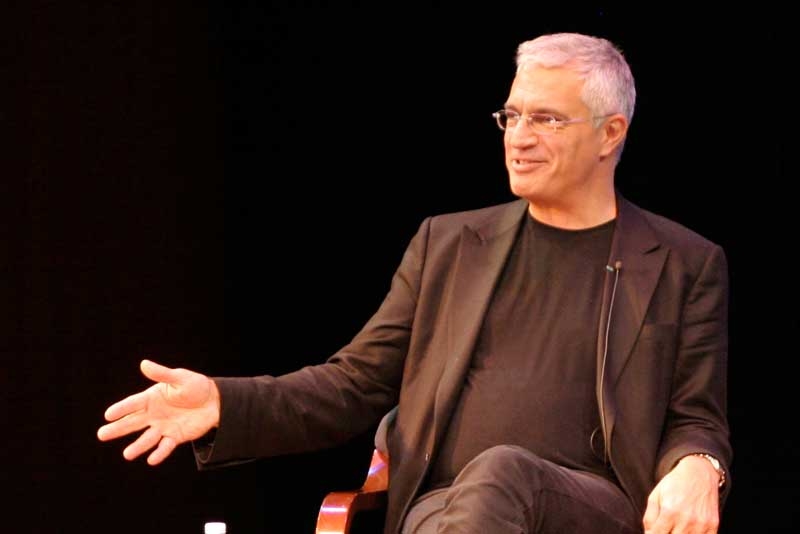
Excerpt: The Cove director Louie Psihoyos discusses the recent SeaWorld tragedy, and similarities between his film and Avatar, at Asia Society, March 9, 2010. (2 min., 15 sec.)

Excerpt: The Cove director Louie Psihoyos discusses the recent SeaWorld tragedy, and similarities between his film and Avatar, at Asia Society, March 9, 2010. (2 min., 15 sec.)

Oscar-Winning Director of 'The Cove' on Campaign to End Controversial Hunts

NEW YORK, March 9, 2010 – Louie Psihoyos, director of the Oscar-winning documentary The Cove, says increasing awareness about health risks associated with eating dolphin meat is key to ending the slaughter of the intelligent marine mammals.

While the The Cove tells an animal rights story about the treatment of dolphins, Psihoyos emphasized the human health implications of the practice during a discussion at the Asia Society with New York Times science reporter Andrew Revkin, just two days after the film's Academy Award win for Best Feature Length Documentary.

"I don’t think we are going to win this issue in Japan on an animal rights issue…we are going to win it on the humanitarian reasons," Psihoyos said.  "It is a crime against humanity when people are serving poison as food.  The provisional limit [of mercury] is 0.4 parts per million; dolphin meat has anywhere from 5 to 5000 times more mercury than allowed by Japanese law."

The Cove uncovers a hidden dolphin hunt along the remote coast of Taiji, Japan that results in the death of up to 23,000 dolphins annually.  Fueled by the demands of a multi-billion dollar dolphin entertainment industry, potential show dolphins are selected from the corralled herd while those left behind are slaughtered and sold for their meat. Due to the dolphin’s position at the top of the oceanic food chain, the resulting meat—often covertly mislabeled—is contaminated with highly toxic levels of mercury.  

Psihoyos shared an anecdote about sitting next to a senior Japanese Fisheries Agency official on a 10-hour flight to an International Whaling Commission meeting.  Psihoyos showed him footage from the film, and asked how he felt being in charge of the 5000 tons of toxic dolphin meat served around Japan every year.  Psihoyos reported that the official’s response was, "I am in charge of food security, not food safety."

Much has been written about The Cove being an eco-thriller or an environmental Ocean’s Eleven, but Revkin noted that it was the quiet moments that most affected him. "To me, one of the most powerful moments was the fireside discussion of these guys [the Taiji fisherman] quietly remembering when the sea was thick with blue whales and sperm whales."

On ending the slaughter in Taiji, Psihoyos reflected how sad it is that "the only way we can save their lives now is to prove that we have made their environment so toxic that we shouldn't be eating them."  On his goals for the film, he said: "I wanted this film to inspire a legion of activists, not just on dolphin and whale issues, but on environmental issues."

Responding to those that suggest the film is culturally insensitive, Psihoyos stated, "Just look at the film. This isn't an indictment against the Japanese people. We want to give them the information that they don’t have readily available."

Reported by Leah Thompson

Bless you for bringing this to the world! I once was blind and now I see, THANKYOU. As hard as it was to watch, I am extremely grateful for it because now my eyes are open. Through out the film, I kept feeling that this is a huge cry for Love. We all can answer the call to Love and connect to one another. The only thing that transends all, is LOVE. So, let us see in one another, that Love resides there inside. We just need to call it forth and pull it out from our ignorance so we can bring it to the light and correct it with LOVE.
the film was so hard to see... my marine science teacher showed me the film and the whole class was surprised to know what they did to the dolphins. the dolphin is my favorite animal so when i saw the film i felt like crying... i asked my teacher if we could so anything about it and she said to check online. that is what i did and now im e-mailing you to see if i could find out what page, e-mail, or phone number i can comunicate to so i can help save the dolphins... i am a minor, i am 17 years old but i still want to help... please e-mail me to (eli_lauru1@hotmail.com) to give me any info of what you know... thankyou soo much and i will really appreceate the information...
Was invited to go to a launch of the movie last night in Cape Town.As I am not an animal activist,I was not even aware of the movie "The Cove".Went actually with my wife who supports any anti-animal abuse.So,I watched the movie and was totally blown away.Hats off to the people who risked their lives to bring the footage.I know that this movie is powerful enough to stop the mutilation,its just a question of when ?? I actually want to email the Japanese cabinet and ask them personally how they would feel if I take their children into a yard and start flinching them with spikes until they die of blood loss and exhaustion.(Not the same ?? - actually Dolphins have more emotions than humans and they feel discomfort and pain even if it is not their own) . A good comment my wife made:Because the dolphins actually are aware of the slaughter,its their way to sacrifice themselves for the greater cause of correcting the wrongs of our unconscious humans.I have defnitely been made aware and will actively encourage everyone I meet.I work with the business community & local government and this is the place where action FIRST needs to happen.As the guy said:If we cant stop this,there is literally no hope for us human beings on this earth.So - unite the people and exploit the murderers and sadistic mutilators of this world.
I am from Dominica and I just watched The Cove and I must say that it was such a shame having our country associated with supporting Japan with the killing of dolphins when in our own Island no fisherman or other would do such things, Here the majority respects and appreciates dolphins and I and I do believe that I can speak for majority of Dominicans when that we are so happy that the powers that be repented from keeping such bad company as Japan.
As a child who loved going to Marineland and Ocean Park so much that she dreamed about becoming a marine biologist, I am saddened by the hard truths that "The Cove" has brought to the fore, yet also emboldened by it. At the Q&A, Louis Psihoyos said that they "won't win" on the animal rights issue, so the issue becomes serving mercury-ridden dolphin meat to schoolchildren, which I think most will agree is bad. Even if dolphin meat was safe to eat, I'm doubtful that 23,000 dolphins need to be killed annually to meet consumption needs. Others in the audience brought up that everyone needs to eat; the Japanese and Aleutians have a history of eating whale meat; and what is the US doing about bison slaughter, anyway? Of course the speakers did not have ready answers for these related questions, but I am glad that a 92-minute documentary about a tiny town in Japan has set off a ripple effect to the world at large. What are we doing to safeguard our oceans and those who live in it, and how can we preserve their lives and in turn, preserve our own?
Hi, my name is Kavya and I am from India. I saw the The Cove and was astounded by whats actually happening to dolphins in Japan. This is also in respect to other marine species who are being culled despite the banning of whaling in the 80's. What Ric O Barry has portrayed is that its not only dolphins which are soon going to be endangered but also a large number of other mammals whose future is constantly threatened. I applaud his team, hardwork and the difficulties they went through to make this moving documentory. We need people like him to show us the truth, whats actually happening and how each one of us can learn to make a difference in this world. Congratulations on winning the oscar this year, you`l have won the hearts on many through your message. Cheers!
First, please watch the following three YouTube clips. http://www.youtube.com/watch?v=TrJfsH7wsFc http://www.youtube.com/watch?v=dGLw0EIRKog http://www.youtube.com/watch?v=y2bP3nabN1M Second, please separate the issues of food safety, species preservation, and ethics of hunting, eating, showing animals clearly when discussing this issue. They are logically different issues.
I am really hoping that this screening and the Oscar nomination will bring this slaughter to the forefront for more debate and action. Pressure needs to be put on Japan to stop this practice but more importantly we need to stop using these intelligent animals in the amusement parks where their smiles are mistaken for happiness, but in reality are intense stress and often suicide.
The Cove's exposure of the relationship between the dolphin hunt in Japan and the big business dolphin and orca captivity is highlighted by recent events at SeaWorld Orlando. It seems to me that if SeaWorld's mission really was education and conservation, then they would be publicly and actively helping to shut down the slaughter dolphins in Japan - a slaughter that is a direct result of marine parks searching for show dolphins and attempting to emulate SeaWorld's success. After the trainer's death at SeaWorld last week, I started to read a series of articles by Jason Hribal which detail the history of orca attacks in captivity. In fact, this was the third human Tillikum had killed. These attacks are not actually that rare in captivity, and yet there are no known attacks of humans by orcas in the wild. What does this tell us? But The Cove also sheds light on the issue of mercury poisoning. We are polluting our oceans to such an extent, that one of the most compelling reason to stop killing dolphins for some people might actually be that their bodies have become, to quote director Louie Psihoyos, "toxic dump sites." It is unhealthy to eat this meat, and that the meat is being mislabeled and sold covertly is very scary - the Japanese people have the right to know what they are eating.
I am so pleased that 'The Cove' is bringing this horrible slaughter to light. I am very hopeful that this film will show the Japanese people what is happening in their country and they demand the end to this practice. I'm also hopeful that people are starting to realize the cruelty behind keeping these beautful, giant creatures in aquariums and zoos - it's so unfair to impose this on them for our entertainment. I'm grateful that there are people out there like Ric O'Barry who are working to save these animals and create public awareness!

Post new comment

Your comments are welcome, please adhere to our guidelines

Be respectful. Personal attacks will not be tolerated; nor will profane, abusive or threatening posts.

Keep it short (150 words or less), Stay on topic.

Asia Society reserves the right to moderate all comments and remove or edit for guideline violations. Thank you.

The content of this field is kept private and will not be shown publicly.
Type the characters you see in this picture. (verify using audio)
Type the characters you see in the picture above; if you can't read them, submit the form and a new image will be generated. Not case sensitive.